
The Dynjandi might just be the most beautiful waterfall in Iceland. Hidden deep in the heart of the Westfjords, this enormous waterfall sits at the head of a fjord.
So here are a few facts about Dynjandi:
Height: 100 meters
Coordinates: 65.732849, -23.199853
Accommodation: Hótel Flókalundur
Location: From the ring road, take road 60 to the north-west (250 km, gravel road)
Direct access: ❌ No (you park a little below the falls and have to walk up)
Hike: A few minutes uphill along a path, passing several smaller waterfalls
Reachable without a 4×4: ✅ Yes (the gravel road is quite bumpy though!)
Dynjandi the thundering waterfall
The name Dynjandi loosely translates to “the thundering one” or “the roaring one”. Where that name comes from becomes obvious pretty quickly as you approach this massive giant. You can hear the thunder of the water from far away, shortly after you first spot the white waterfall against the cliff face. No matter which direction you come from, you have to drive along a long fjord to reach the waterfall, and at first you might not even recognize it as one — from a distance, all you see is a bright spot at the head of the cliff. The closer you get, the more clearly the huge waterfall reveals itself.
The Westfjords are the oldest part of Iceland — they formed over 14 million years ago. The terraced Dynjandi was probably created, much like the horseshoe canyon Ásbyrgi, around 10,000 years ago at the end of the last great ice age. Back then, glaciers pushed their way across the land or melted away, carving out huge furrows as they went. The one that Dynjandi plunges down was most likely formed in exactly this way.
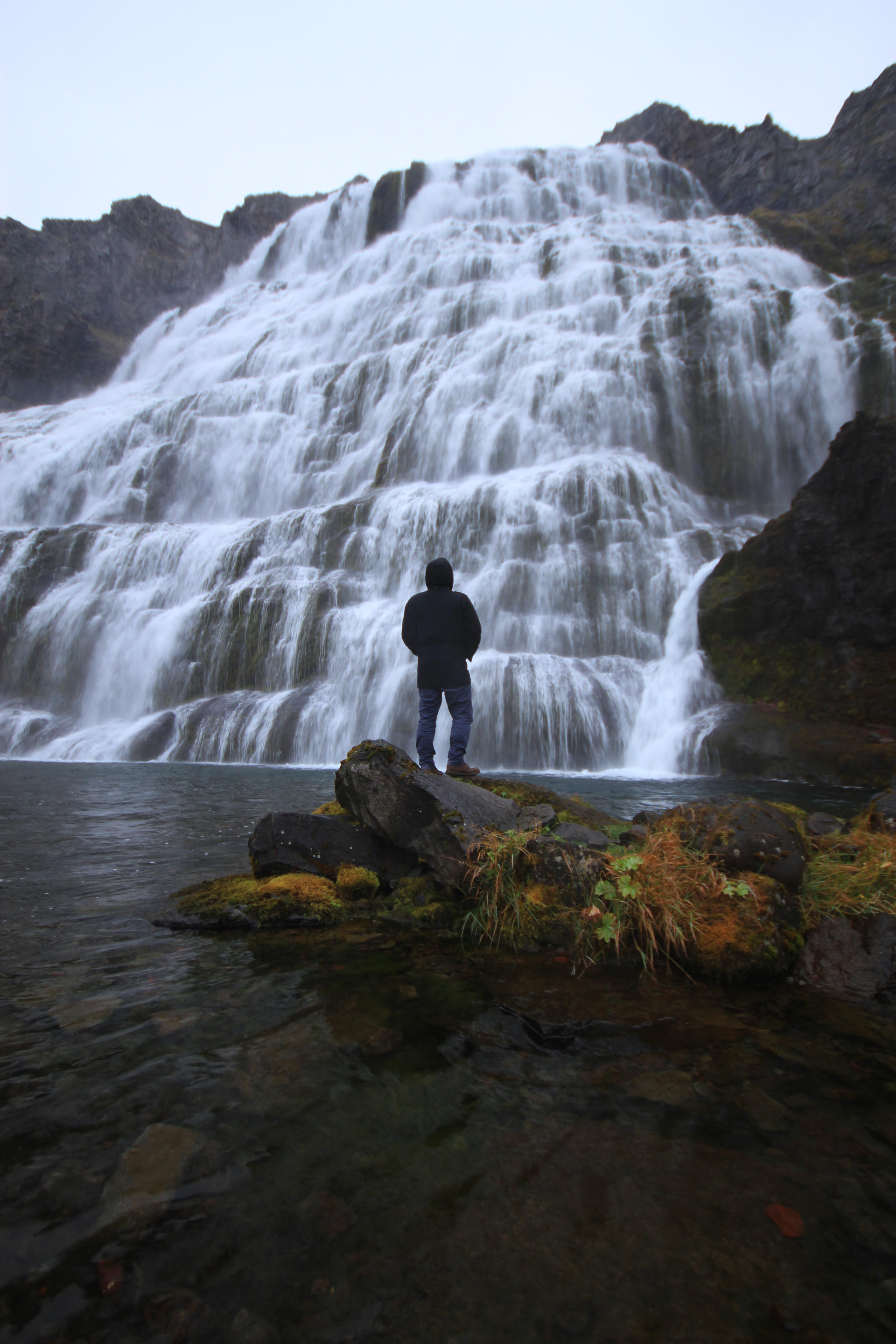
The waterfall is almost 100 meters tall and about 30 meters wide at the top. On its way down, it gradually widens to twice that width, a good 60 meters. The water spreads out evenly and naturally creates that characteristic white veil. You probably know this look from countless pictures of waterfalls in Iceland, where it is usually achieved with a long exposure. Here at Dynjandi, that is not even really necessary — even with a fairly normal exposure time, the veil effect appears almost automatically.
Below the big waterfall there are seven more, smaller waterfalls. Among them are Hundafoss (Dynjandisá), Göngufoss, Háifoss (Dynjandisá), Úðafoss and Bæjarfoss (Dynjandisá). The river Dynjandisá, which feeds the waterfalls from several nearby lakes, flows into the Borgarfjörður (Arnarfjörður) at its end.
The landscape around Dynjandi consists mainly of grass and bushes, with the occasional birch tree and birch shrub. One plant that is rather special for Iceland is the sundew, which can be spotted in some of the damp spots by the smaller waterfalls. The entire area around the waterfall has been a nature reserve since 1981 and the environment here is particularly fragile — the soil is very loose and therefore prone to erosion. So please, as everywhere in Iceland, stick to the marked paths and be a responsible visitor!
Camping at Dynjandi
As far as I know, the campsite at Dynjandi is closed and there is no way to camp right at the waterfall!
There is — or rather was — a campsite right by the waterfall, next to the parking lot. When I was there in October 2017, a photographer who had wanted to set up camp there the evening before told me that a local Icelandic woman had pointed out to him that the campsite no longer exists and that camping is no longer allowed anywhere in the wider area around the waterfall.
The most recent reports about the campsite that I could find online date back to 2015. Most overview sites for campsites in Iceland also no longer list a campsite directly at Dynjandi. According to them, the nearest campsites are Þingeyraroddi, Bíldudalur and Flókalundur.
As always, the general rule applies: wild camping is not generally allowed in Iceland. You may not pitch your tent on private land or in nature reserves, for example. I always recommend heading to designated campsites!
If you, dear reader, know more about this or have more up-to-date information: please let me know in the comments!
Hiking at Dynjandi
Some people already call the short trail up to the waterfall a hike, but you won’t be walking for more than 20 minutes. There are a few meters of elevation gain, but the path is neither strenuous nor rough!
Apart from that, there are no hiking trails in the immediate area. I suspect this has to do with the fact that the ground here is very sensitive — so let me stress once again: stick to the marked paths!
A few kilometers to the north lies the farm Hrafnseyri, the birthplace of Jón Sigurðsson, the founder of Iceland’s independence movement in the 19th century. Attached to it is a small museum that is well worth a look.
Verdict: Dynjandi
The Dynjandi is without a doubt one of the highlights when it comes to waterfalls in Iceland. It is hard to put into words, which makes it all the more impressive once you are actually standing in front of it.
Have fun in Iceland!
No Comments Yet