
Davidsgjá, David’s fissure, is one of my favorite dive sites in Iceland. Located in lake Þingvallavatn, the crack stretches over several hundred meters and takes divers through Iceland’s largest natural lake at a depth of 15-20m. So if you’re looking for an alternative or an addition to diving in Silfra, this is the place for you.
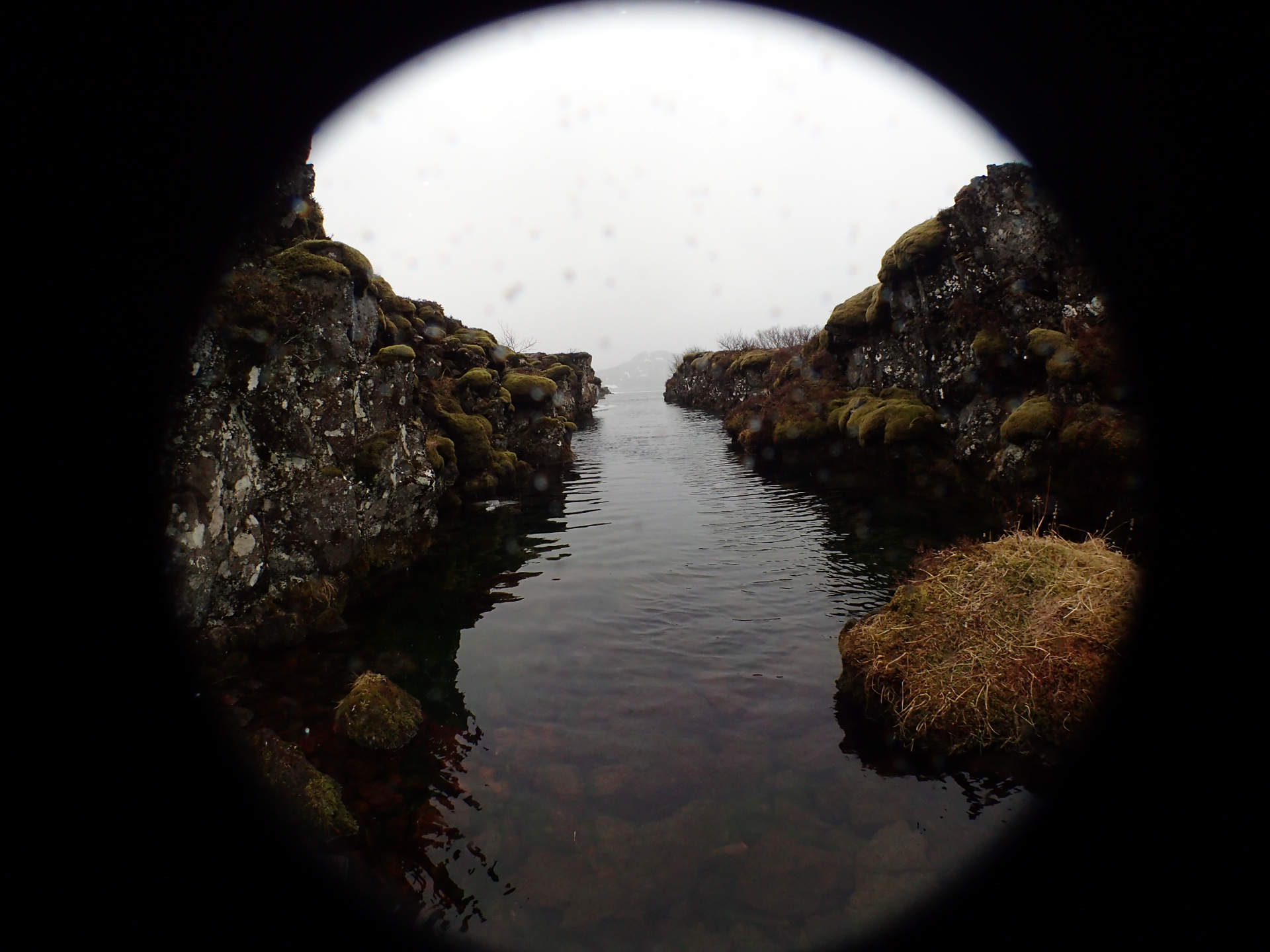
Davidsgjá, David’s Fissure in Iceland’s Largest Lake
The dive site is only ten minutes from Silfra and takes you right into the lake that the crystal-clear water from the Silfra fissure flows into. Unfortunately, the water doesn’t stay quite that clear here — depending on wind and weather it gets a little murky. Visibility ranges from dozens of meters down to less than an arm’s length.
Inside the fissure itself the visibility is usually excellent, since the cold water down at the bottom is clear and the suspended particles collect in the warmer water above it. So once you’ve reached the canyon in the lake, you can descend and enjoy the good visibility. If you’ve dived Silfra before, you’ll notice clear similarities as well as major differences: The rocks here are narrower and shorter, but they’re tinted in the same deep blue that you find in Silfra.
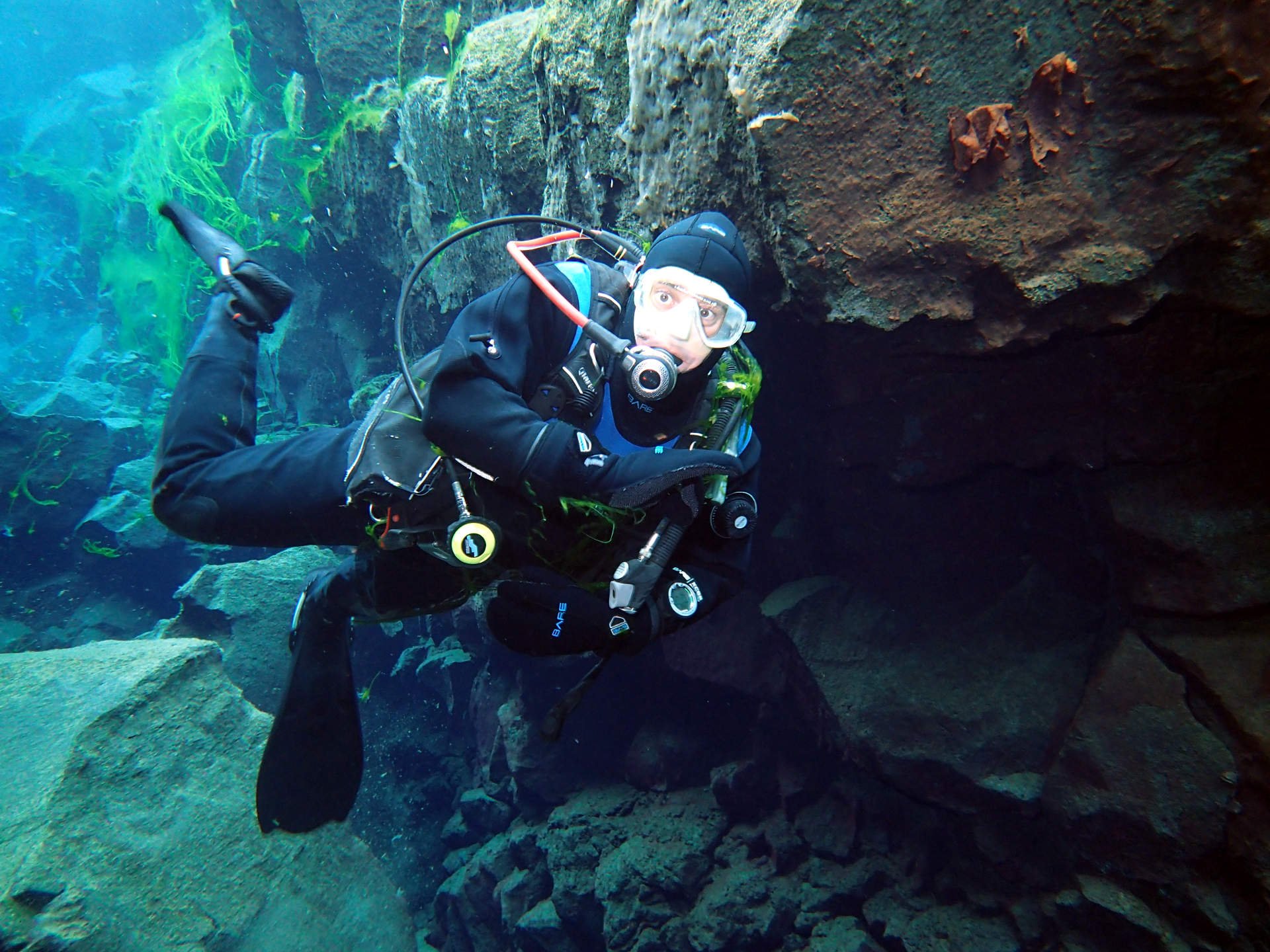
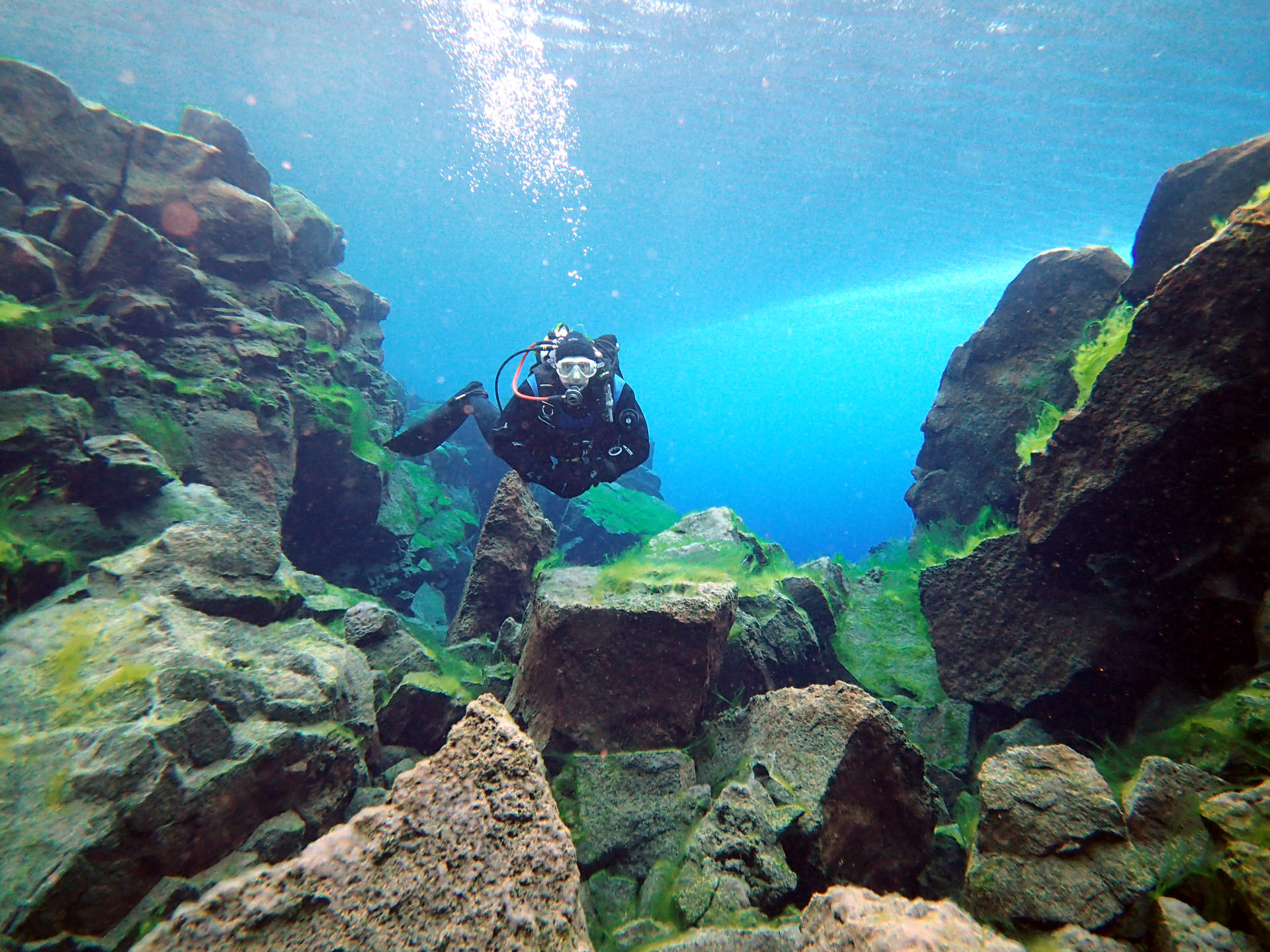
The same very strict rules for divers apply here in Davidsgjá as well. That means: you’re not allowed to dive deeper than 18m. In some places that’s not exactly helpful, as the fissure drops down to a depth of more than 20m. There are also some beautiful swim-throughs here that you’re allowed to pass through (careful: always dive within your personal limits and inside your comfort zone!). You won’t find a cave system like the one in the national park here, but the rules forbid diving in caves anyway.
Another difference is the likelihood of seeing something alive here (algae aside). While only a few tiny fish live in Silfra, Davidsgjá is home to plenty of big fish. Among others you’ll find trout and arctic char here that reach lengths of a good 50cm and often show up in small groups. If you dive calmly enough you can get within a few centimeters of the fish, but normally they swim off once you exhale within a few meters of them.
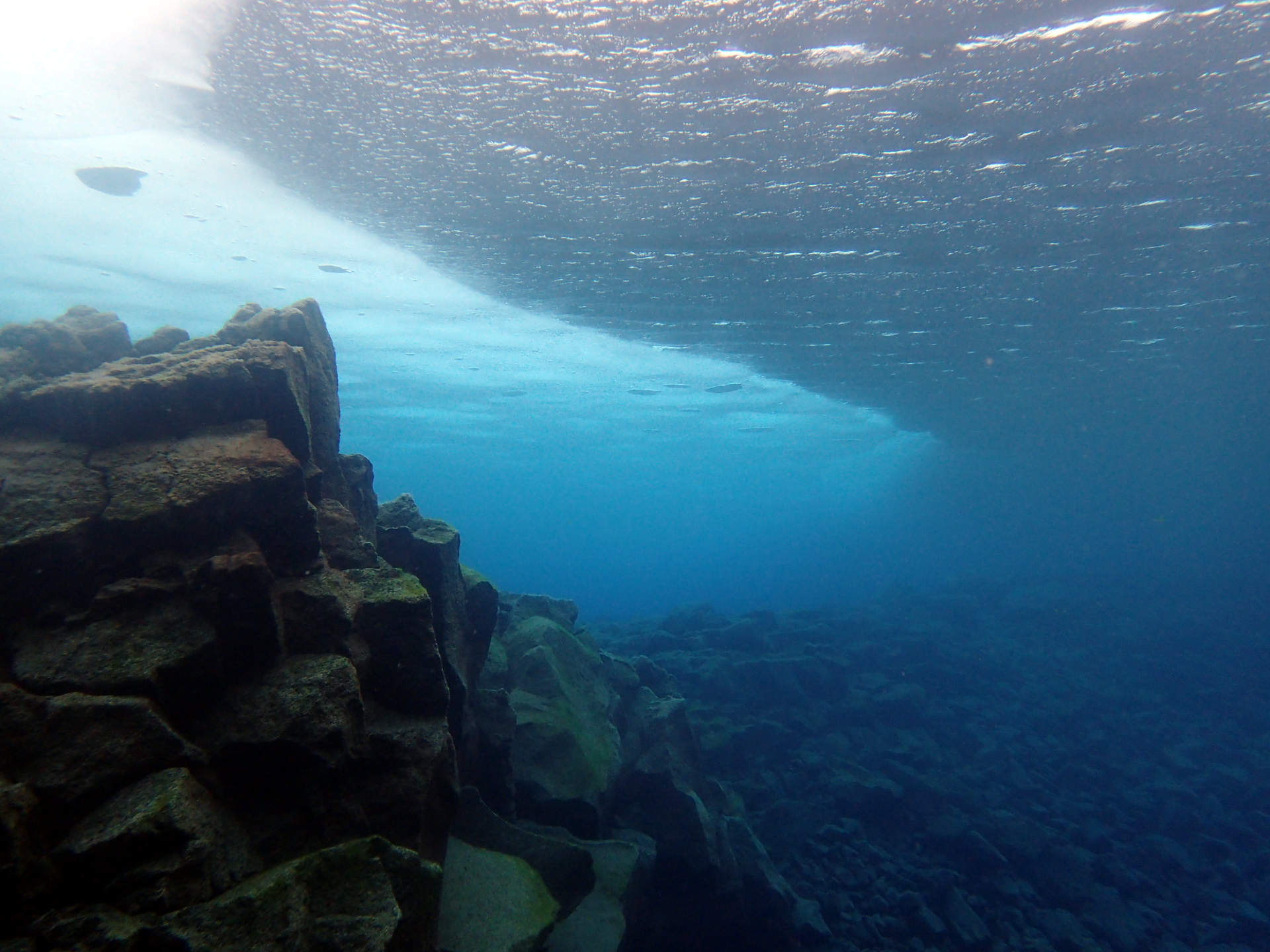
I dived here for the first time on a cold, snowy winter day in April 2015. While the lake was still completely frozen over in most places, we got lucky: the edge of the ice lay right along the fissure, perfectly placed for us, so we could descend safely and at the same time dare a little excursion under the ice.
At the entrance to the dive site the conditions are dreamlike: the water is crystal clear and lots of bright green algae drift around, blocking your view of the rock walls. Here, too, fresh, cold glacial water emerges from the rock and flows along the cliffs into the lake.
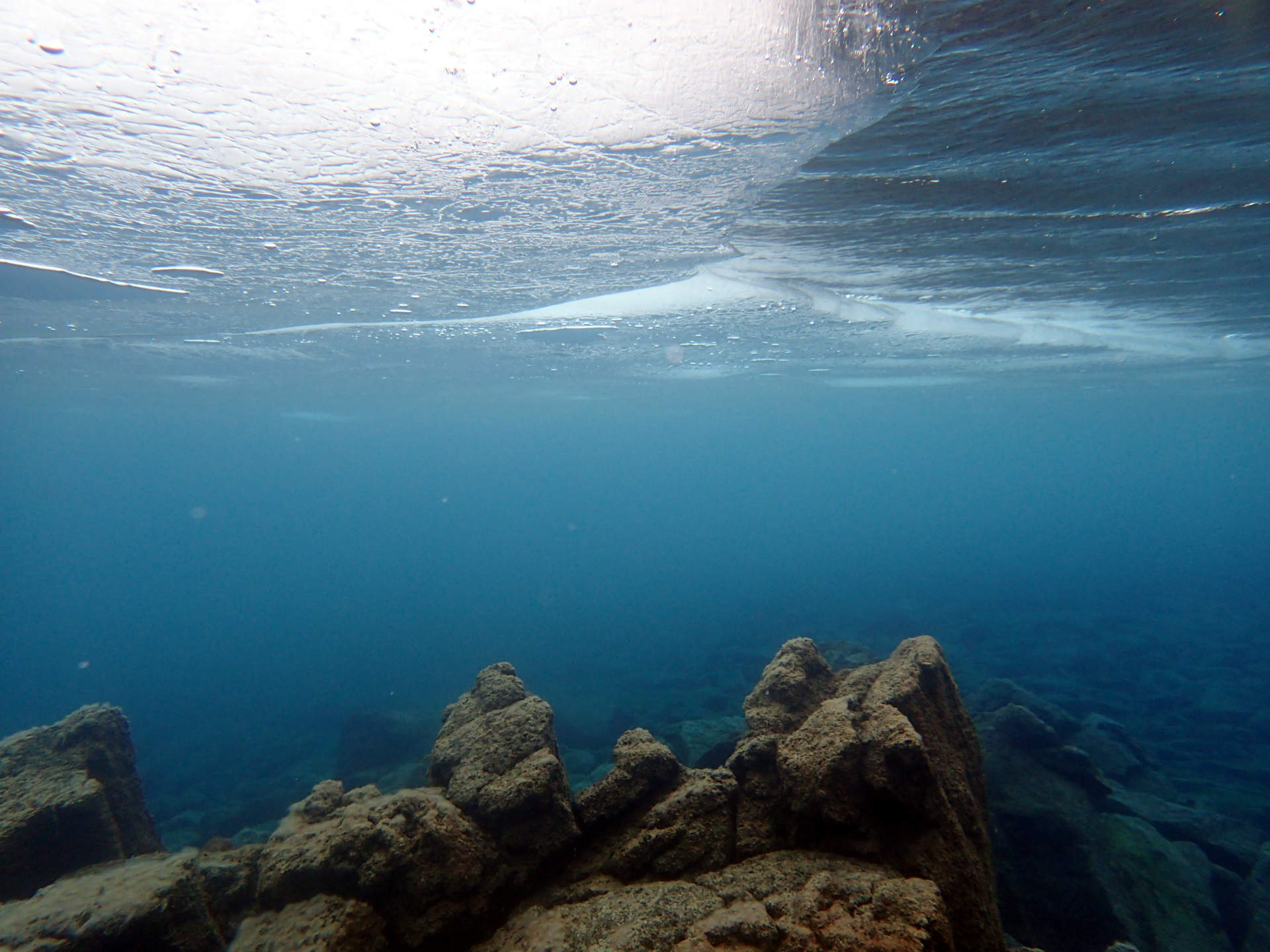
We dive across a width of about 20-30m and down to a depth of around 15m. Since Davidsgjá is rarely dived, you regularly find artifacts between the boulders along the sides and on the bottom. We find old Icelandic coins (krónur, no silver, sorry…) and an old tube of paint that must have come from one of the painters who, years ago, created landscape portraits of the lake with the volcano behind it.
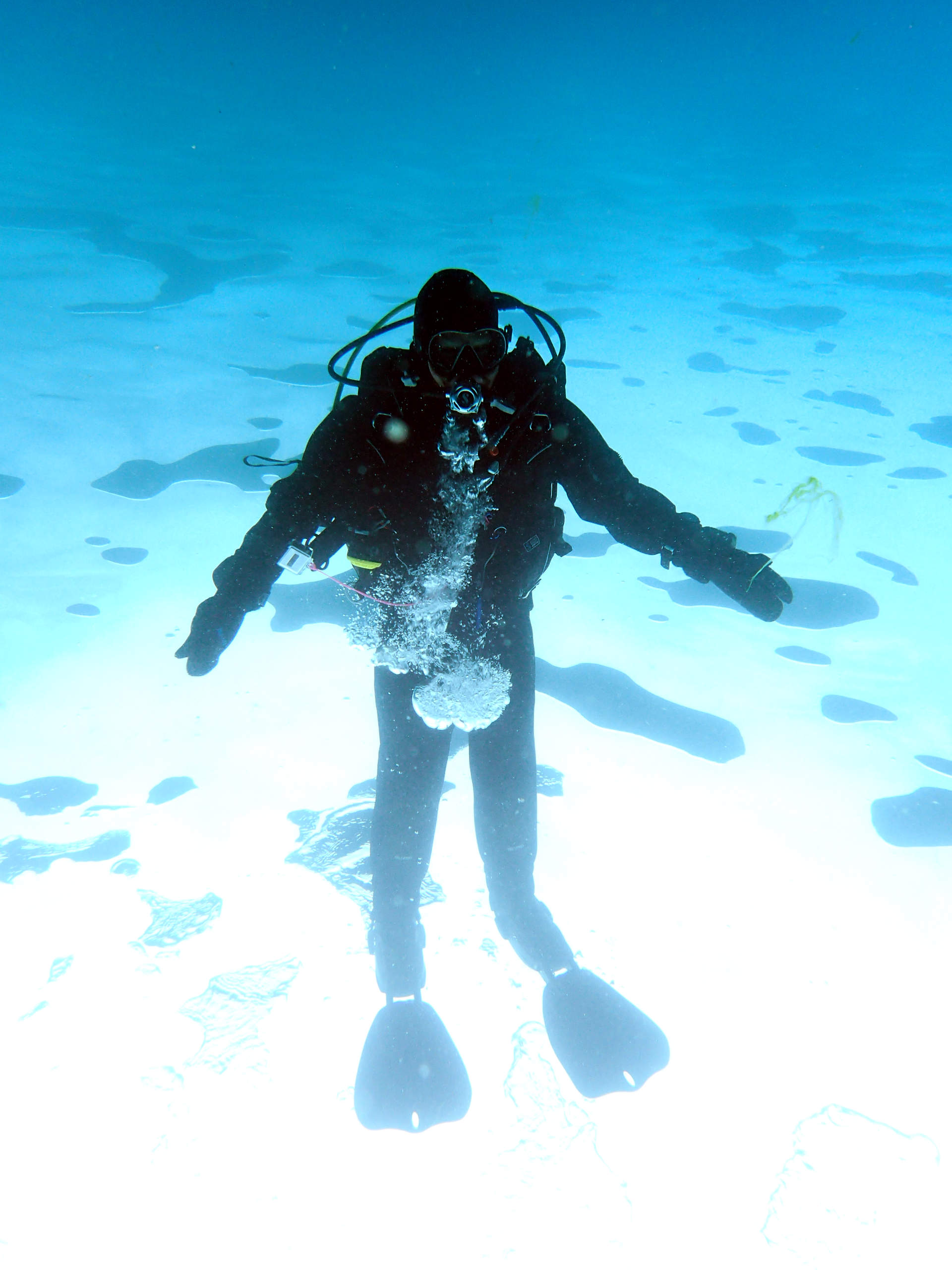
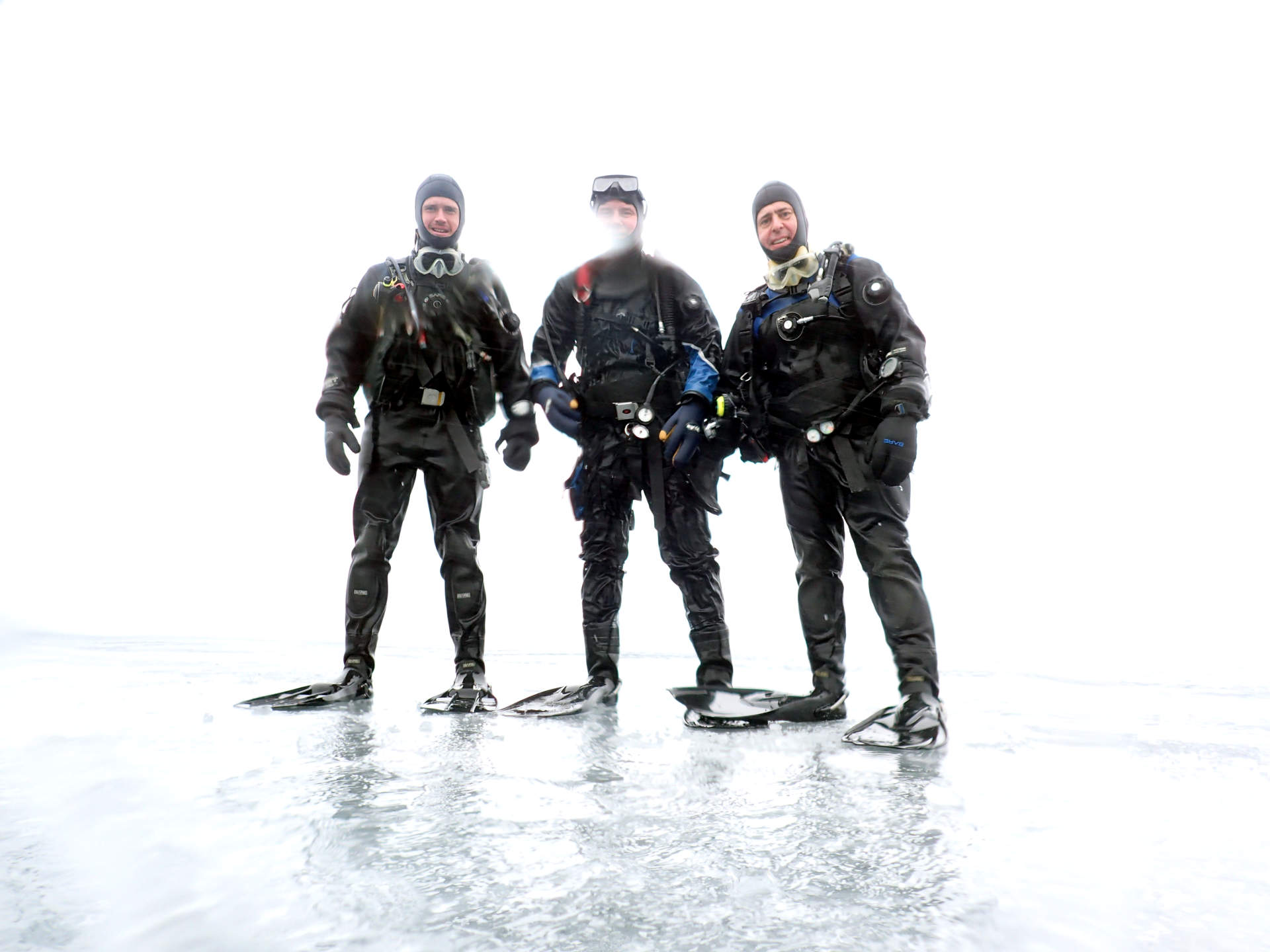
When we reach the end of the fissure, we see the pale blue ice sheet and take a few photos of ourselves in front of this impressive backdrop. The water temperature under the ice drops once more, now down to 1°C. Everyone is aware that we have to be careful from here on, so we only dive a few meters past the edge of the ice. Just enough to let some air into our boots and walk along the ceiling.
In the distance, out in the lake, we can make out the shadows of large trout. A small group patrolling under the ice at a safe distance. The animals are almost half a meter long and look huge through the dive mask. They keep their distance, though, and enjoy their peace and quiet. Davidsgjá is inhabited by a large number of fish, which makes this place particularly interesting for anglers — so you’ll regularly find fishing lines and hooks on the bottom.
I wonder whether you could actually stand on the ice and whether the edge is stable enough to heave yourself up onto it. At first I make that calculation without the good 20kg of equipment I’m carrying on my back and give up on the idea for the time being. A little later I try again with the support of my fully inflated BCD and a few powerful fin kicks from a depth of 2-3m and — et voilà — I slide out onto the ice sheet on my belly. Even up here, standing up makes me realize how much lead I’m carrying and how heavy the steel cylinder on my back is. But I’m standing at the edge of the ice sheet and can enjoy the view across the lake and down to my buddies. The ice holds even at the edge, and we decide to film a giant stride.
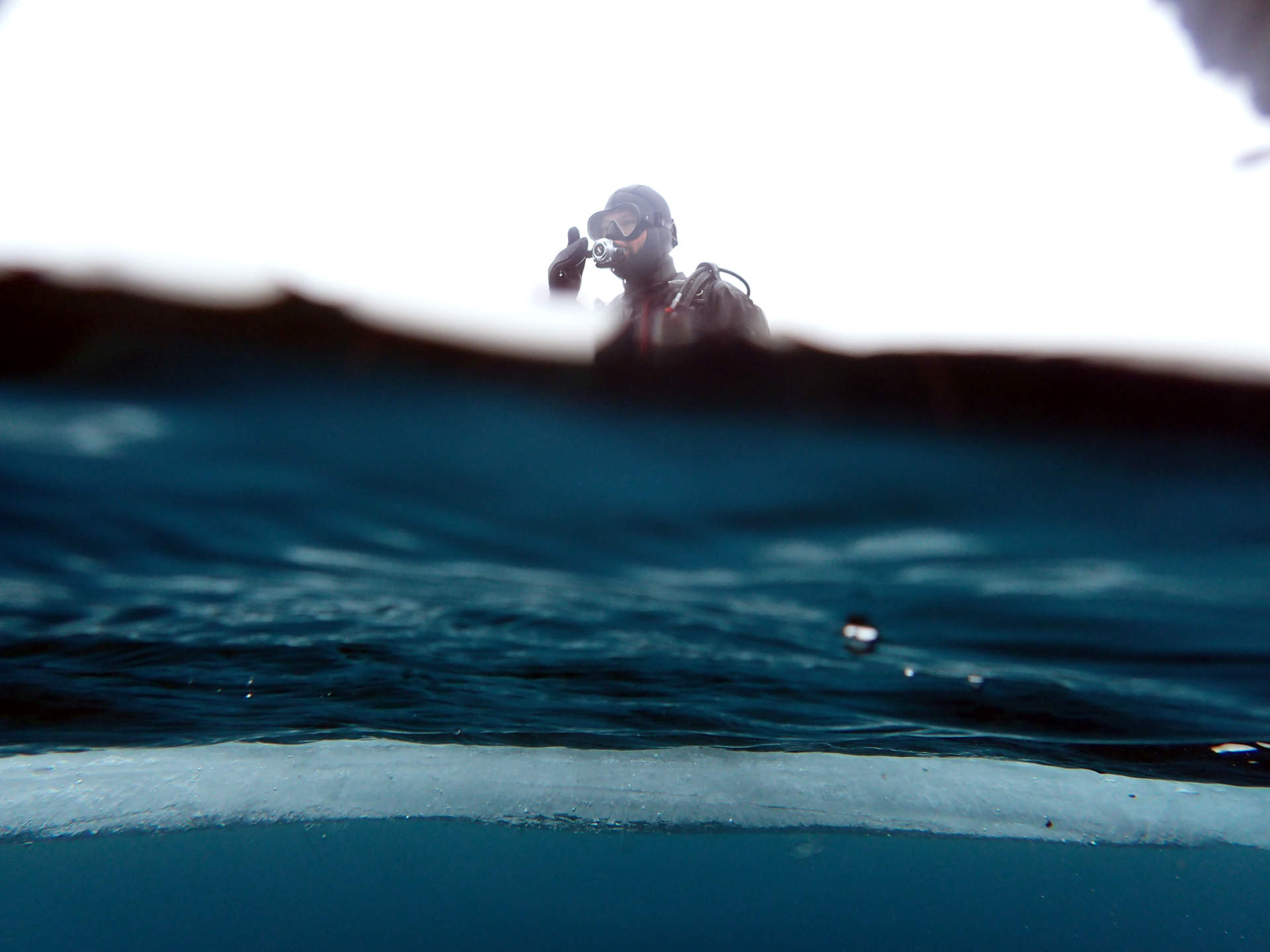
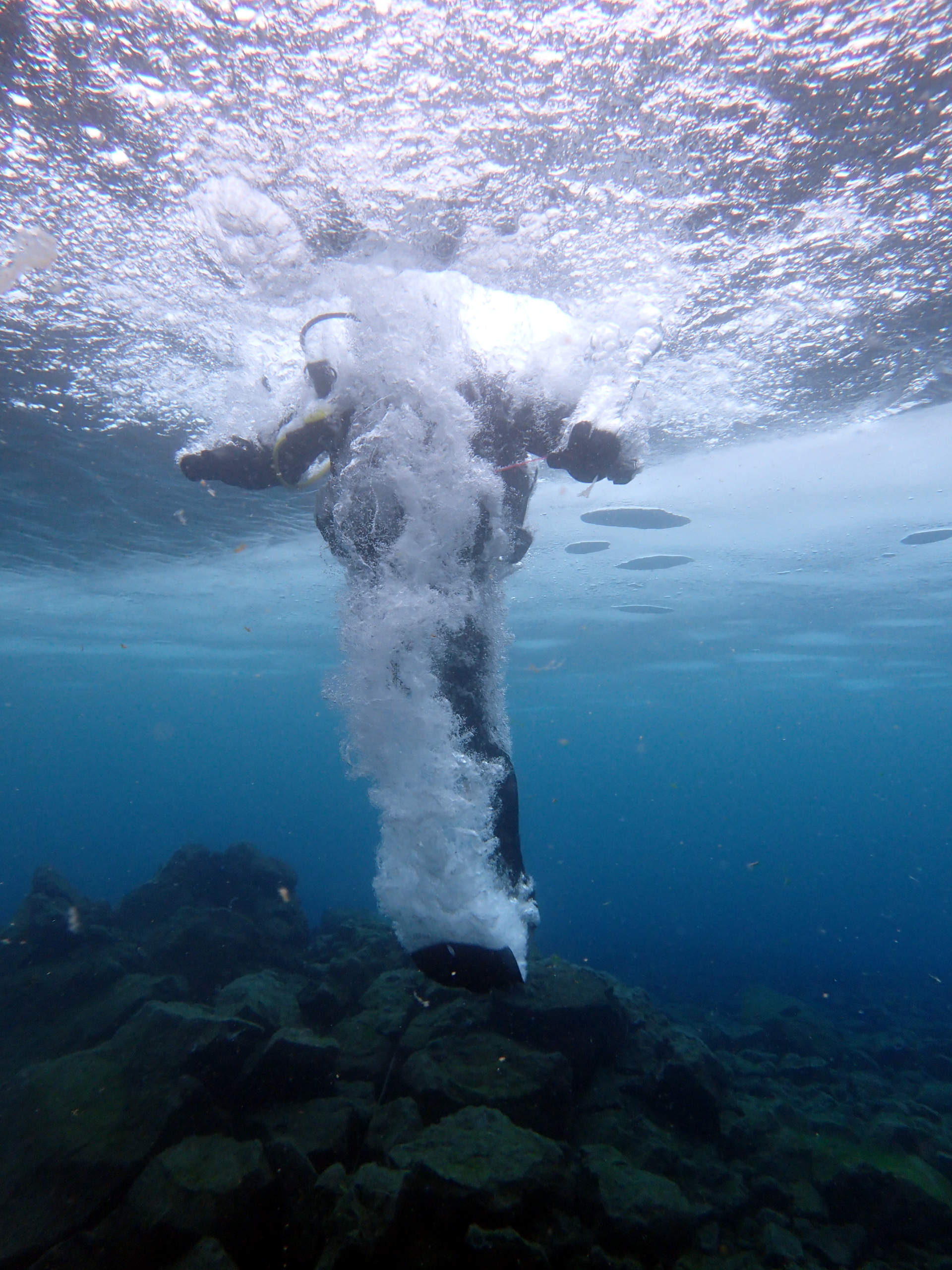
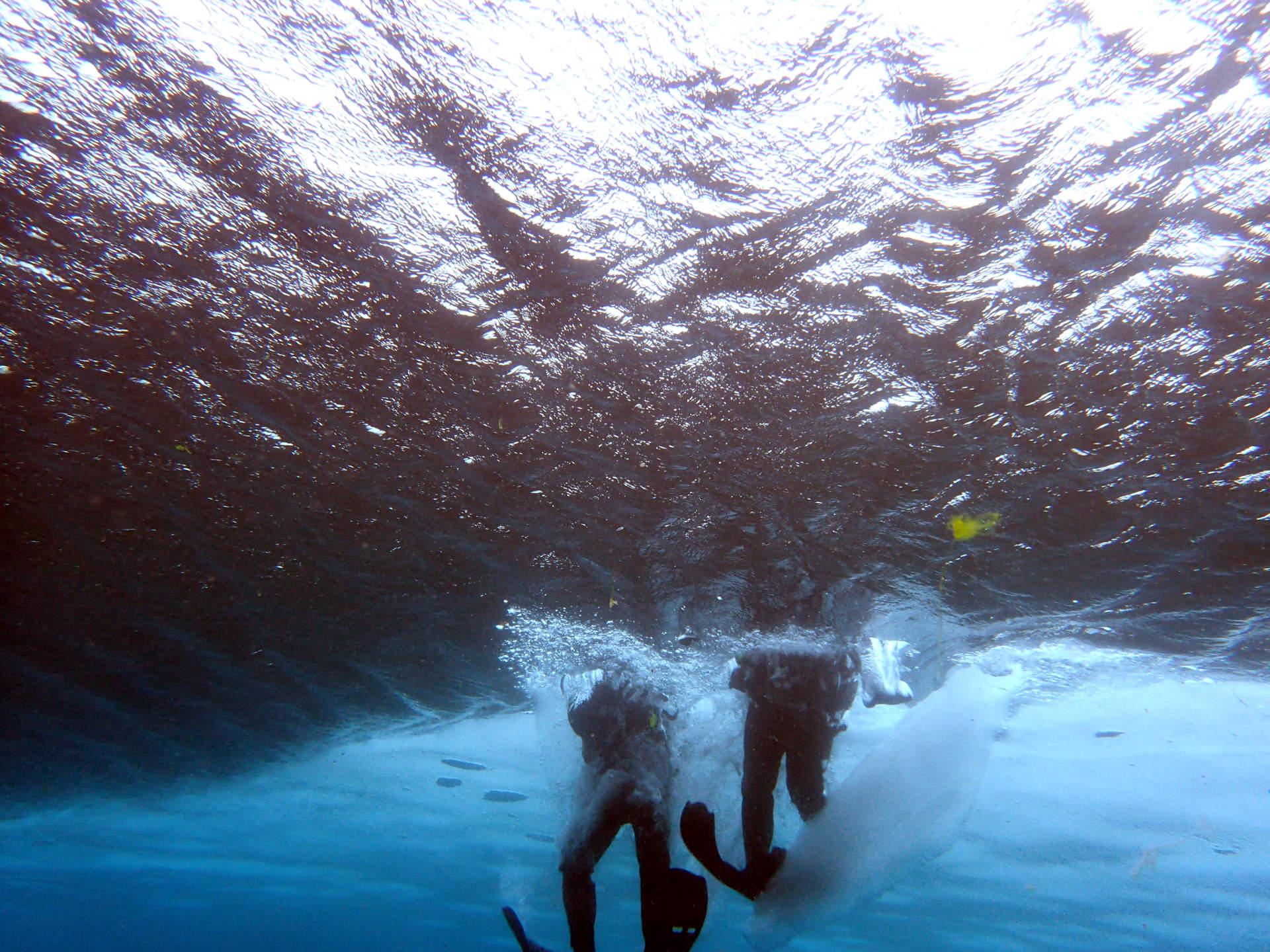
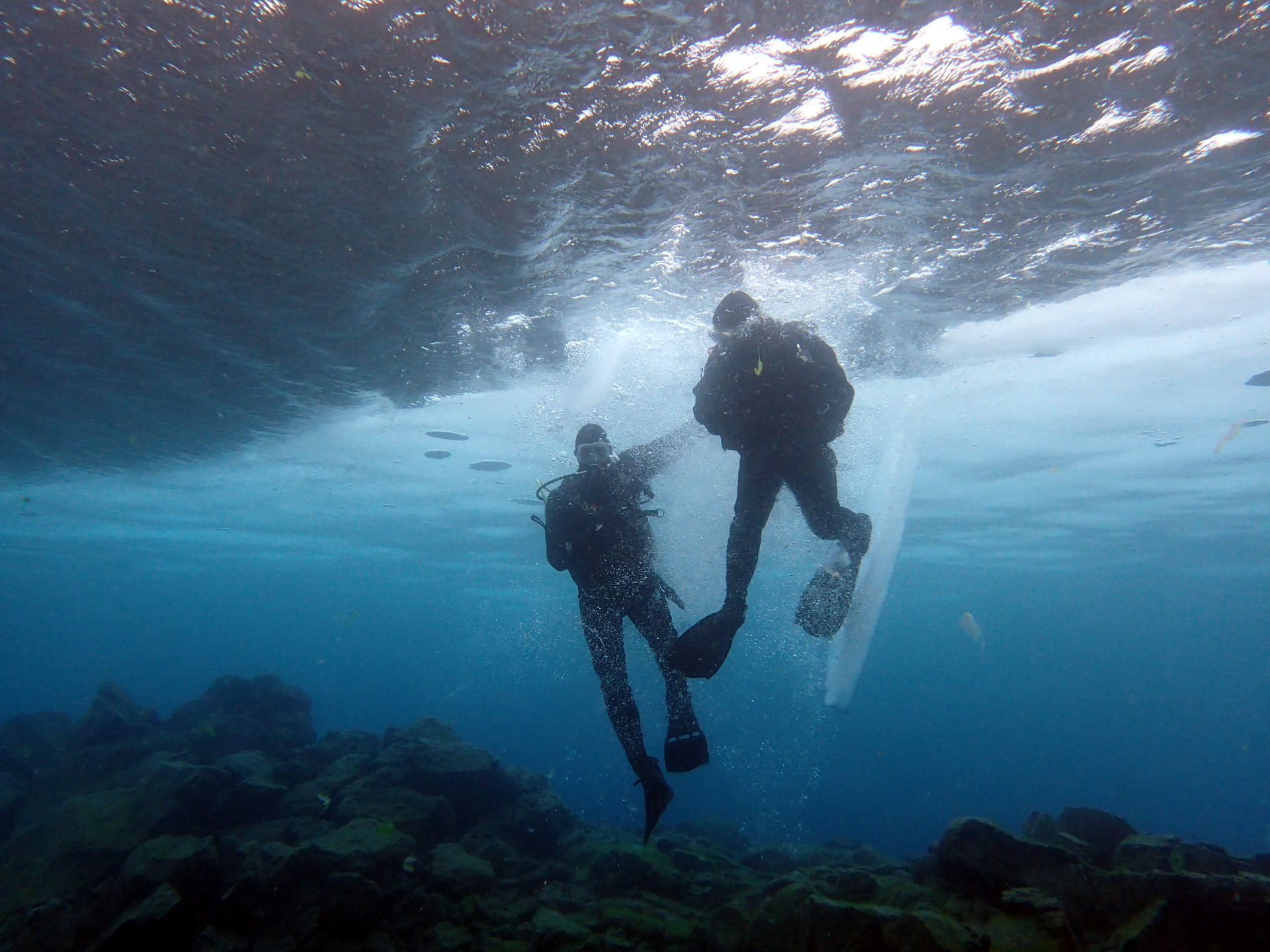
The others are of course highly interested as well, and minutes later everyone is sliding toward the volcano on their bellies, like sea lions in Antarctica. Three are better than one, so the plan for a triple giant stride is quickly hatched and I descend to photograph the gang underwater. While I sink down briskly I count to ten: one, two, thr… and with a loud crash my colleagues plunge into the water, accompanied by big chunks of ice, and I just barely manage to hit the shutter in time. A great photo from a great dive!
We swim slowly back toward the exit and come across a single trout on the way. It isn’t quite sure what to make of us, and at some point it darts away beneath us and out into the lake while we continue on our way to the shore. Along the way we find a few more artifacts and a great spot with an easy swim-through that we don’t let pass us by.
Diving in Davidsgjá
If you want to dive in Davidsgjá, your best bet is to contact one of the local dive centers. They all know this spot and can take you there, into the lake, and guide you around in it. The entry is at a shallow spot with lots of rocks and is therefore very comfortable. From there you follow a rope to the fissure and can then dive it to the north or to the south — the shore is always to your east.
In summer there isn’t much to watch out for here. Please be careful with regard to fishing lines and hooks. If you want to do the swim-throughs, bring a light and coordinate with your buddy.
If you want to dive here in winter, pick days when the ice sheet no longer sits above the fissure. Ice diving can quickly become dangerous, and if you don’t have the appropriate training you should refrain from it! Please always dive within your limits. Have fun in Davidsgjá 🙂
The Best Dive Spots in Iceland
During my three-month divemaster training in Iceland I got to see a variety of dive sites, and here is a list of my absolute favorite spots for diving in Iceland:
Diving where life began: the hydrothermal vent Strýtan
Diving between the tectonic plates in Silfra, Iceland
Diving in a geothermal lake – Kleifarvatn in Iceland
Diving in the North Atlantic at Garður in Iceland
No Comments Yet