
Iceland’s Blue Lagoon — what is it actually all about? Where do I find the Bláa Lónið? How did the hot spring come to be? How much does admission to the modern spa cost? What makes this thermal bath in Iceland so special? When is the best time to visit this hot pot — and is it even one?
We keep getting lots of questions about Iceland’s number one attraction, and in this post I want to give you the best possible overview of the Blue Lagoon in Iceland.
Here we go…
Booking the Blue Lagoon: Opening hours and admission prices
First things first if you want to visit the Blue Lagoon: The spa area is open for different hours depending on the season, generally from 8 am at the latest until at least 9 pm. Here are the exact opening hours:
1 Jan – 24 May from 8:00 – 22:00
25 May – 28 Jun from 7:00 – 23:00
29 Jun – 19 Aug from 7:00 – 00:00
20 Aug – 30 Nov from 8:00 – 22:00
1 Dec – 31 Dec from 8:00 – 21:00
On public holidays:
24 Dec from 8:00 – 15:00
25 Dec from 8:00 – 17:00
31 Dec from 8:00 – 17:00
The admission prices depend on the package you choose. The Comfort package costs between 55€ and 78€, the Premium package between 78€ and 101€, and the Retreat Spa package between 460€ and 554€. Prices vary by time of day: The last hour before closing is always the cheapest.
Children up to 13 years get free admission. Children younger than 2 years are unfortunately not allowed in yet.
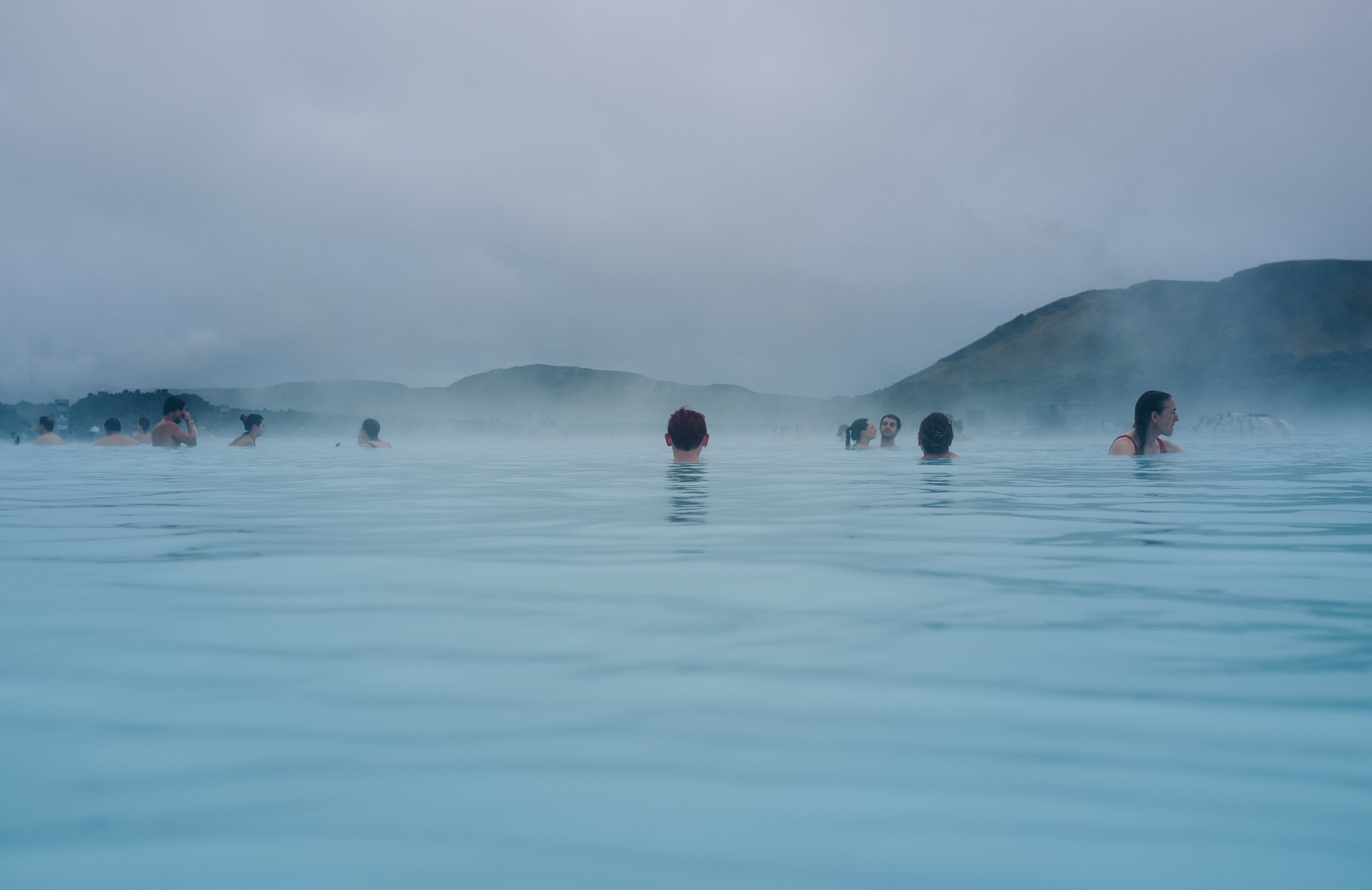
Which packages are available at the Blue Lagoon
So what exactly is the difference between Comfort, Premium and Retreat? Always included are admission to the Blue Lagoon itself, a towel and a drink of your choice. You can also help yourself at the silica stations and treat yourself to a face mask while you bathe here.
The Premium package additionally includes a bathrobe. I actually bought one back in 2013 and still love it today! You also get an extra face mask and a reservation at the restaurant (the food costs extra, and unfortunately you don’t get to keep the bathrobe either).
The Retreat package is a completely different Blue Lagoon experience. A separate area has been created where things are quieter and where visitors are put in the mood and introduced to the Blue Lagoon as part of the “Blue Lagoon Ritual”. You also get access to a second, special restaurant and the skincare products.
What is the Blue Lagoon in Iceland and how did it form
Contrary to a claim that persisted for a long time, the Blue Lagoon is only partly a natural phenomenon. In 1976 the Svartsengi geothermal power plant was built, and during construction the excess water had to go somewhere: That’s how the original Blue Lagoon came to be.
At first, the excess water, which is extremely rich in minerals, was simply channeled from the geothermal area into the lava field next door. After the water, mixed with seawater, had been used to heat the fresh water for Reykjavík, it was simply directed into the nearby cracks and fissures of the Illahraun. Over time the minerals settled and a large standing body of water formed: The Blue Lagoon.
As time went on, a few small showers and a hut were set up. In 1990 the potential of this place was recognized and the Blue Lagoon as we know it today was built. Today, only photos from that era remind us of the old Blue Lagoon.
Why is the water of the Blue Lagoon so good for your skin?
Valur Margeirsson suffered from psoriasis and decided, in the early 80s, to spend a day bathing in the power plant’s wastewater: He wanted to leave no stone unturned to ease his condition — and lo and behold, the time spent in the Bláa Lónið, as he called it, worked wonders!
Besides various minerals such as silica, chloride and sodium, the water also contains algae and a certain type of bacteria that has so far only been found in the Blue Lagoon. The algae are green, but combined with the silicates they give the water a blue — sometimes slightly green — shimmer.
These ingredients apparently work extremely well, especially for psoriasis. That’s why treatments for patients are offered in a private part of the Blue Lagoon, and there is now a wide range of skincare products connected to these treatments.
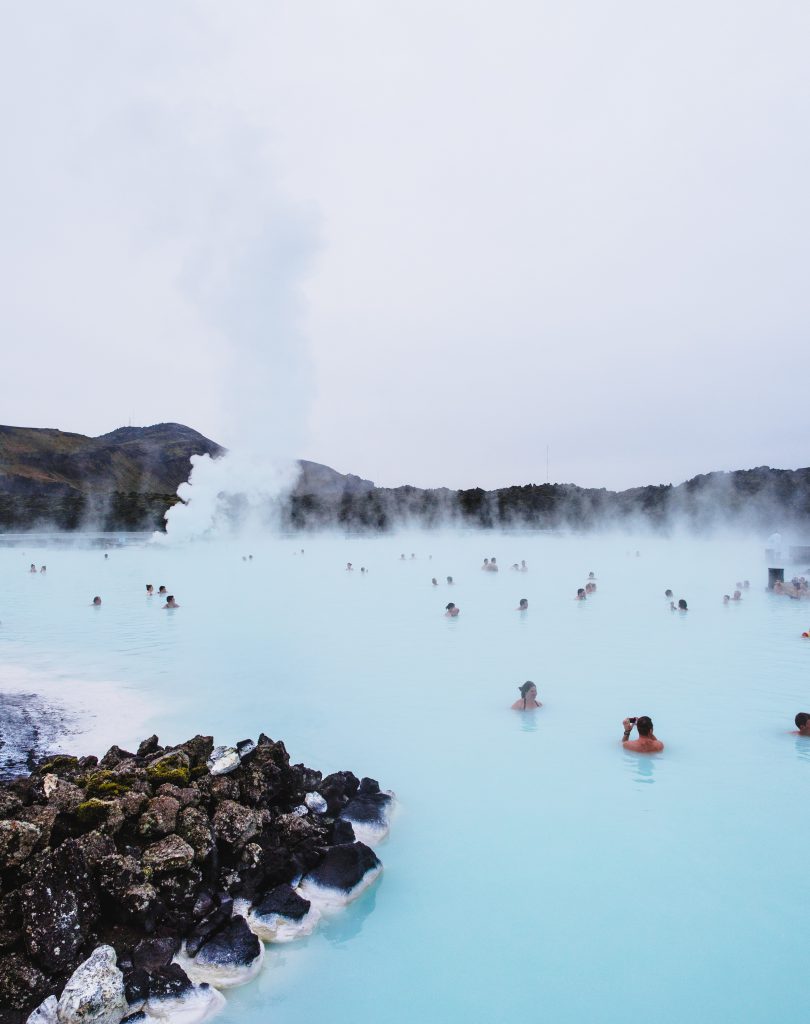
What are the water temperatures in Iceland’s Blue Lagoon?
The entire Blue Lagoon is constantly heated to 39°C. That’s the ideal feel-good temperature to spend 1–2 hours in the blue-green water. In many spots of the lagoon you can feel wonderfully where and how the hot water is fed in. The temperature is checked regularly and always kept at this pleasant level.
Many hot pots in Icelandic swimming pools are heated to 38°C, 40°C, 42°C or even 44°C — everyone has to find out for themselves how hot they like it: Be careful with your circulation. Personally, I’d rather sit for an hour at 40°C than keel over after 20 minutes in a 44°C hot tub.
Hotels around the Blue Lagoon in Iceland
The Blue Lagoon has two hotels, the Silica Hotel and the Retreat Hotel.
A room at the Silica Hotel starts at 535€ and can be booked with either one large bed or two separate beds. The hotel houses the restaurant ‘Lava’, which serves traditional Icelandic cuisine: The choices include a fish menu, a lamb menu and a vegetarian dish. Available as a two- or three-course menu for 53€ and 60€ respectively.
At the Retreat Hotel you get the full luxury package starting at 1132€: The suites of various sizes offer everything your heart desires. From upscale furnishings to a private lagoon, you really get it all here. Directly attached to the suites is the restaurant ‘Moss’, which remains mysteriously silent about the dishes on offer. The view, in any case, is one of a kind! This is the ideal spot for couples; travelers with children are recommended the Silica Hotel as an alternative.
There are also a few smaller guesthouses and hotels near the Blue Lagoon, which aren’t right by the blue water but are considerably cheaper.
Reviews and experiences from the Blue Lagoon in Iceland
But enough with the facts! What most people really want to know: What is it actually like at the Blue Lagoon? Is visiting the Blue Lagoon worth it? In short: We need some first-hand experiences!
Briefly, my own experience: I visited the Blue Lagoon for the first time in 2013, then again in 2014. The two visits were very different: While in 2013 I still felt like I was in a beautiful bathing establishment and enjoyed floating around in the blue water under the starry sky, the 2014 visit was rather stressful: In 2013 I had probably just caught a particularly quiet day, but on that evening in 2014 absolutely nothing here was relaxed anymore. I was constantly maneuvering between selfie sticks, it was loud and unrelaxed, and at times I felt like I was swimming in beer and red wine rather than water.
Would I recommend visiting the Blue Lagoon in Iceland: Yes and no. Yes, if you haven’t seen it yet and if you want a spa day with all the trimmings. No, if you want to experience nature, if peace and quiet matter to you and you don’t like crowds. Would I go again myself: Absolutely, yes! Whenever I feel like having a day like that. However, I’ve now seen the Blue Lagoon several times, so the alternatives to the Blue Lagoon listed below would take priority for me first.
Thank goodness I’m not the only one who can give you a first-hand account of the Blue Lagoon. So if you’d like to read a few other opinions, I’ve gathered a few reports from other bloggers for you:
Franzi from Coconut Sports visited the Blue Lagoon in 2016 and wrote a few lines about it.
Christine from Lilies Diary also wrote a short review of the Blue Lagoon: Click.
Sabrina from Hallo Island was there in 2013 and 2015 as well and gathered some info: Click.
Nil from Jilsblog was in the blue water in 2017 and even saw the northern lights there — a great read: Click.
If you’ve recently been to the Blue Lagoon and would like to contribute your experience, let me know in the comments!
Alternatives to the Blue Lagoon in Iceland
There are quite a few alternatives to the Blue Lagoon in Iceland, but when choosing you should know exactly what you’re in the mood for: The Blue Lagoon is a spa, not a swimming pool or a hot spring. Iceland has all of that, and depending on what you fancy, you can pick from these alternatives…
The Secret Lagoon
The Gamla Laugin, the secret lagoon, is essentially the natural counterpart to the Blue Lagoon. It lies relatively close to the Golden Circle and is often included in extended tours. Things are a bit less luxurious here, but you’re closer to nature. You can strike the ‘Secret’ from the name though — here too you’ll need to book early in high season and will very likely share the water with plenty of other travelers.
The Secret Lagoon is best understood as a geothermal lake — there’s no spa, no restaurant, no bathrobes, but pure nature instead.
Fontana Spa on the Golden Circle
Located directly on the Golden Circle you’ll find the Fontana Spa. As the name suggests, this is not a lake, hot pot or swimming pool. The Laugarvatn Fontana offers various hot pots, saunas and steam baths. Next door there’s a small lake, which however is unheated.
Your physical well-being is taken care of here too: The attached geothermal bakery serves lava bread, which will remind most of us of gingerbread. There’s also a dinner buffet.
Myvatn Nature Baths
The Nature Baths in the Myvatn region are often touted as THE alternative to the Blue Lagoon, and I too think there’s no denying it. The way the baths at Myvatn are today is how you can imagine the original Blue Lagoon before the massive renovation of the past 2–3 years.
The water has a similar color to that of the Blue Lagoon, but there are no algae in the water here. The water, which is very high in sulfur, is said to be good for asthma patients, and people with skin problems are certainly in good hands here too. Myvatn also has steam baths and a sauna, as well as a small cafeteria serving home-baked lava bread.
Geosea Geothermal Sea Baths in Húsavík
Brand new and therefore still a real insider tip for a few more weeks: Geosea in Húsavík
Located right in the capital of whale watching and directly on the Atlantic, it sits a little north of the town center and is an absolute gem of modern architecture. The water in the pools is geothermally heated seawater and is fed from two sources. Thanks to the constant flow, all the water is exchanged several times a day, so there’s no need to treat it in any way. There are several large pools, beautiful modern showers and a small restaurant.
Open from 9 am to midnight in summer and from 12 to 22:00 in winter — just long enough for the northern lights if you’re lucky!
Krauma Spa in Reykholt
A small but excellent spa in the Reykholt region is the equally brand-new Krauma Spa. The nice thing here is that you’re a bit off the tourist trail, so it’s less crowded. At least relatively. Right next door are the hottest and wildest geothermal springs in the country. These also feed the baths. There are steam baths and a small restaurant — everything your heart desires.
Perfect for a relaxed stop after visiting the Viðgelmir cave or Into the Glacier.
Beer spa Bjórböðin in Árskógssandur
A somewhat unusual and therefore noteworthy spa: Bjórböðin
Here you can make yourself comfortable in wooden tubs and bathe in beer. The mixture in the tubs consists of beer, water, hops and yeast. The smell certainly takes some getting used to, but the effect seems to be positive for the skin. You should bathe in the beer for a total of 25 minutes and then relax for 25 minutes afterwards.
Conclusion: The Blue Lagoon in Iceland
My conclusion: The Blue Lagoon in Iceland is probably one of the most debated attractions. Some say it’s a pure tourist trap, not authentic, and should therefore be avoided. Others are enthusiastic and visit the lagoon regularly on their vacation in Iceland.
I’d place myself in the middle: If you’ve never been there and enjoy spa visits, then the Blue Lagoon is definitely for you. If you prefer things natural, like having few people around you, or your budget isn’t that big, I’d recommend the alternatives.
In any case, I hope the info in this article helps you decide and plan your trip to Iceland!
Have fun in Iceland!
Photos from Unsplash.
[…] The Blue Lagoon is about as natural as an indoor tropical water park: not at all. It came into being during the […]