
Northern lights and Iceland go together like fire and ice. At least up there!
Countless myths and stories surround the lights in the sky that every visitor to Iceland hopes to see. In this post I want to gather everything worth knowing about the topic and give you tips for hunting the aurora in Iceland.
Here we go…
When is the best time to see the northern lights in Iceland?
The best time for northern lights in Iceland is the winter months. If you are there between September and May, you definitely have a good chance of catching the aurora.
That said, it’s not simply a case of “the more winter, the more northern lights”. December and January, for example, statistically see less activity than September, October and March. These are the most active months and offer the highest probability of a combination of activity and cloud-free skies.
In summer, on the other hand, you’ll have a hard time: the northern lights are active in summer too, but it becomes difficult to impossible to see them because the sun only sets for a very short time and the remaining light is still enough to hide the aurora from the human eye.
You should also avoid the days around the full moon — something you can actually factor into your travel planning quite easily.
By Theo Schacht – own work, CC BY-SA 3.0
Where are the best places in Iceland to see the northern lights?
Any place with little artificial light is generally a good starting point. The further north you are, the better. Altitude itself helps a little too, but it’s not really critical.
If you open up the map, places like Akureyri and Myvatn will catch your eye, and they are indeed pretty good base camps for aurora hunting. The Westfjords are also relatively well suited, since few people live there and you therefore have little artificial light around you. The entire north is generally a very good bet.
In and around Reykjavik, Þingvellir National Park is your best option. There are even hotels here that specialize in northern lights, such as Buubble and ION. If you want to stay right in the city, your chances of seeing the northern lights drop significantly. Only from a strength of 3-4 upwards do you have a chance of spotting them, and even then they will appear much weaker than somewhere without street lights. If they catch you by surprise and you have no time to book a car or a tour at short notice, your best bet is to head towards the harbour in the west. There are still a few relatively dark corners there from which you can watch the northern lights nicely.
Guided northern lights tours depart regularly from Reykjavik. These probably give you the highest probability of success, because the tour operators are in contact with each other and with various locals at all kinds of locations across the country. If the northern lights are visible anywhere, the tour operators not only know about it immediately, they also know whether there are even better spots.
Tips from readers
- Reykjanesbær / Seltjörn (Thanks Oli)
- Garður (Thanks Oli)
How do I increase my chances of seeing the northern lights in Iceland?
Travel at the right time of year. As described above, that means the winter months, around the equinoxes. So September / October and March / April. In my opinion October is probably the best choice, but unfortunately you can’t really pin it down that precisely.
Study the forecasts closely. The Aurora Forecast from the Icelandic Met Office is practically my browser homepage whenever I travel to Iceland — always open, always up to date. When activity rises, watch the cloud formation during the day and compare it with the cloud forecast. That way you get a good feel for its accuracy and can plan and act accordingly.
Get out into the countryside. If you want to see the northern lights, you have to escape the light pollution of towns and cities. Out into the countryside is the motto — far away from street lights, car headlights and the like. That way you can spot even faint northern lights easily and enjoy the strong ones all the more.
Book a tour. If you’re only in Iceland for a short time, don’t have your own rental car, or simply don’t feel like doing the research yourself all the time: book a northern lights tour with one of the local operators like Extreme Iceland or Reykjavik Excursions. The cost is usually between 50 and 100€.
Keep an eye on the solar cycle. This one is more for the scientists among you: solar storms follow certain cycles, and if you’re in Iceland during a strong phase of these cycles, your chances of seeing the northern lights are higher. The last peak was in 2013/2014 and the cycle lasts 11-12 years. So right now the odds are in your favour, in 2-3 years less so, and another 2-3 years after that things look good again. According to this theory 2020 won’t be a good year for northern lights — let’s see if it surprises us.
What are the northern lights?
The short version: the Aurora Borealis is created when particles ejected by the sun collide with air particles in our atmosphere.
The slightly longer answer: the fluorescent light of the Aurora Borealis comes from charged plasma that the sun hurls towards Earth at a speed of several hundred kilometres per second. It takes about 72 hours to reach our planet and is then deflected by the Earth’s magnetosphere. This creates streams that sweep past us along the Earth, some of them wrapping around the entire globe.
If the plasma is strong enough to push into the atmosphere, it ‘tickles’ the sparse gases up there (nitrogen and oxygen), which then start to giggle and glow.
Auroras exist in many, many places. Besides the very obvious ones like Iceland, Finland and Sweden, there are also auroras on Jupiter and Saturn. And in 2013 you could even admire fairly strong northern lights in the sky over Berlin (which, in turn, fits the solar cycle theory).
What colours are the northern lights over Iceland?
Mostly green.
The colour of the northern lights depends on which gases get ‘tickled’. The green northern lights, which you see most of the time and know from videos and pictures, come from oxygen particles colliding with other oxygen particles. That happens at an altitude of about 100km, roughly 6-10 times as high as an airplane flies.
If you’re very lucky, you can watch oxygen particles at around 200km altitude being bombarded: when they don’t crash into each other, they emit red light from up there. This is only very rarely observed, just a few times a year.
And if you’re really, really lucky, you’ll see nitrogen particles under fire. That shows itself as violet light, and if you’ve ever been allowed to witness it, you have my envy. This spectacle is reserved for a select few — even some Icelanders have never seen any colours other than green and red.
How does the human eye perceive the northern lights?
Differently every time. Some see a deep green, others a light green. For one person the colours blur together, for another they are crisp. This is mainly down to the darkness — you probably know how some people can drive well in the dark and others can’t. The perception of colours in darkness in particular is very individual.
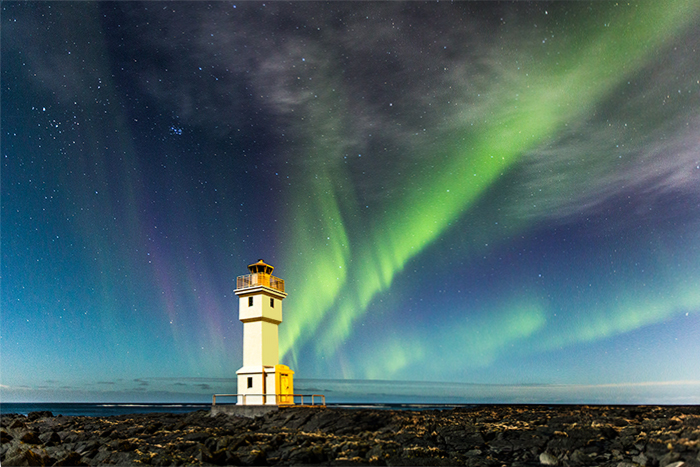
Northern lights can also take on many different shapes. Bands are the most common, but there are also circular formations (corona) as well as curtains and arcs. An aurora usually ends when it changes shape, for example when a band turns into an arc.
How do you best photograph the northern lights?
First, a reality check (skip to the next paragraph now if you’re easily disheartened…)
Most photos and videos of northern lights on the internet are heavily over-edited and give a completely false impression of what it’s actually like!
There, I said it! So if there’s one thing you shouldn’t do before your Iceland trip: look at photos or videos of anything, especially not northern lights.
Let me continue with how not to do it. You can’t take pictures of the northern lights with your smartphone or your GoPro. At least none worth looking at. I tested it once and ended up with black images that I had to filter for differently-coloured content in Photoshop. Uncool!
You need a good camera with a large sensor and a lens that lets in lots and lots of light. On top of that, a tripod is absolutely recommended and possibly a remote control as well.
If you’re using a DSLR, you can experiment with the settings as follows: ISO levels from 400 to 1600 are common, and then it comes down to the exposure time. Autofocus won’t help you here — you need to focus manually; the best approach is to set the focus to infinity and then pull it back a tiny bit until everything is sharp. Exposure times between 4 and 30 seconds are recommended. Ideally you trigger the shutter via a remote release or use a timer, while the camera rests stable and untouched on its tripod.
After that it’s all about trial and error: simply play around with exposure time, ISO and focus until the results are perfect. Always view the images at full size while doing so, because on the camera’s small display, blurriness gets lost in the scaled-down previews.
And once again: don’t be disappointed. What comes out of your camera won’t look like the northern lights pictures you know from the internet. That’s not what it’s about anyway, if you ask me. Inka has written this up very nicely as well, and we also talked about northern lights in the Iceland podcast.
Where do I find a northern lights forecast for Iceland?
First and foremost: in the Iceland App you’ll find a map with sightings, and you can report sightings there yourself as well. You can also get notified when the northern lights have been spotted within a certain distance of you. It doesn’t get easier or more reliable than that!
The Aurora forecast for Iceland offers you a great service where you can check how active the aurora currently is and will be over the coming five days. The data is fairly accurate, and for 1-2 days ahead it’s a really good indicator of how the aurora is behaving and developing.
On a scale from 0 to 9 it shows you the strength of the activity, where 0 means no activity at all and 9 very strong activity. At a strength of 0-3 you will see little or nothing, even in the highlands under a clear sky. At a strength of 4-7 you have a decent chance in dark areas within towns — for example at the harbour in Reykjavik — while in the highlands this activity level can already put on quite a show. Anything above 7 is like hitting the jackpot for northern lights fans. That’s when you get out of the cabin and turn your eyes to the sky!
Now for the unpleasant part of this aurora outlook: the clouds. On the image in the middle of the page you can see a map of Iceland showing the cloud cover. Very often, this is unfortunately where the theoretical fun ends: even with high activity (5+) you won’t see anything if there are clouds in the sky. Even clouds you barely notice during the day become a wall at night. If your aurora hunt fails because of anything, it will most likely be clouds.
[…] so you probably shouldn’t plan your trip around it alone. Still, the chances of catching the Northern Lights here are relatively high, because the coasts are often free of clouds and the light pollution of […]
[…] Two more sights can only be admired in winter, as they remain shy and hidden from the human eye in summer: northern lights and Arctic foxes. While the northern lights really are only visible in winter, the little foxes simply become more trusting in winter and venture closer to the people in Þórsmörk. At this time of year they are also often hungry and on the lookout for food, which is why they tend to come ever closer to the buildings here. If you have a good camera with you, you can take pictures not only of the little furballs but also of the northern lights in Iceland. […]