
Tucked away in the mountains of the Reykjanesfólkvangur nature reserve south of Reykjavik lies Kleifarvatn. This naturally formed lake is remote and far from civilization. The area is quiet and deserted. The lake is not – at least not quiet.
Once you leave the bumpy asphalt road and round the first bend on the gravel track, the lake spreads out before you. Big, gray, motionless. Like a splash of paint on the mountaintop. There’s no visible movement, nothing to suggest that anything could stir here. Yet beneath the gray surface, this place is alive and restless.
Sometimes the water level drops by four or five meters from one day to the next, shrinking the lake’s surface by more than 20%. Where the water goes, nobody knows exactly – the lake covers several thousand square meters and is nearly 100m deep in places. It lies in volcanic territory – Krýsuvík – in a fracture zone. This is where the world is tearing apart, where the tectonic plates drift away from each other and release what usually stays hidden beneath the surface.
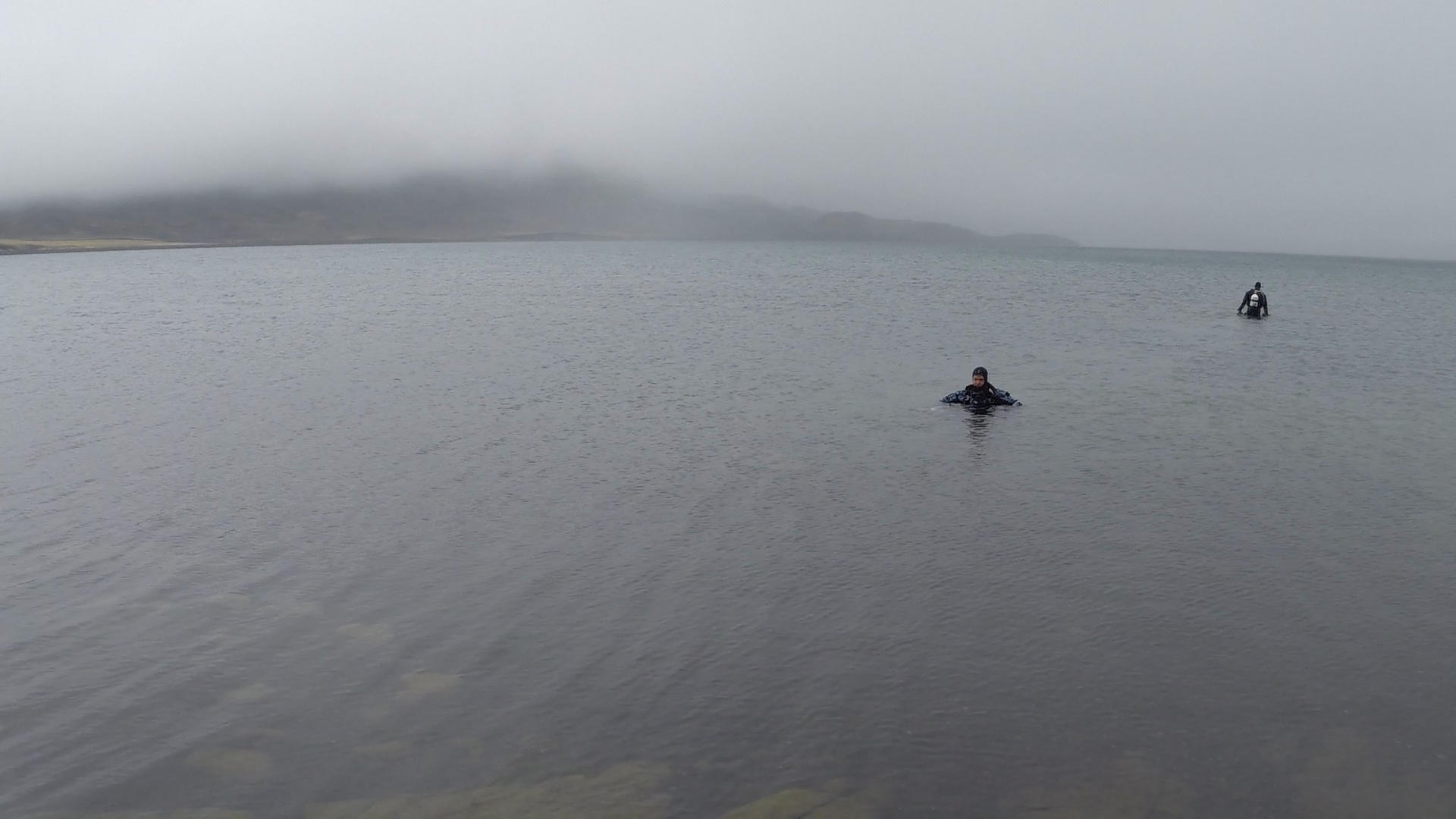
A gray veil hangs over the lake, with a bit of steam rising. It could just be the temperature difference – the weather is strange today. But when it starts to rain, the veil doesn’t disappear. The clouds of steam hover beside the lake, on the beach next to the hills.
We drive along the shore and stop on the pitch-black sand when large boulders block our way. Here the dive is briefed short and sweet: get in, dive, get out. We know how this works, after all. We’re supposed to follow a red line, if we can find it, until we reach the hot springs.
It’s raining. That’s not much of a problem at the start of a dive. We change quickly in the car, strap the heavy tanks onto the BCDs and swing them over our shoulders. Fins and masks only go on once we’re in the water – until then it’s a few minutes on foot along the beach into the initially shallow lake. When it gets deep enough, we strap on our fins, put on our masks and descend.
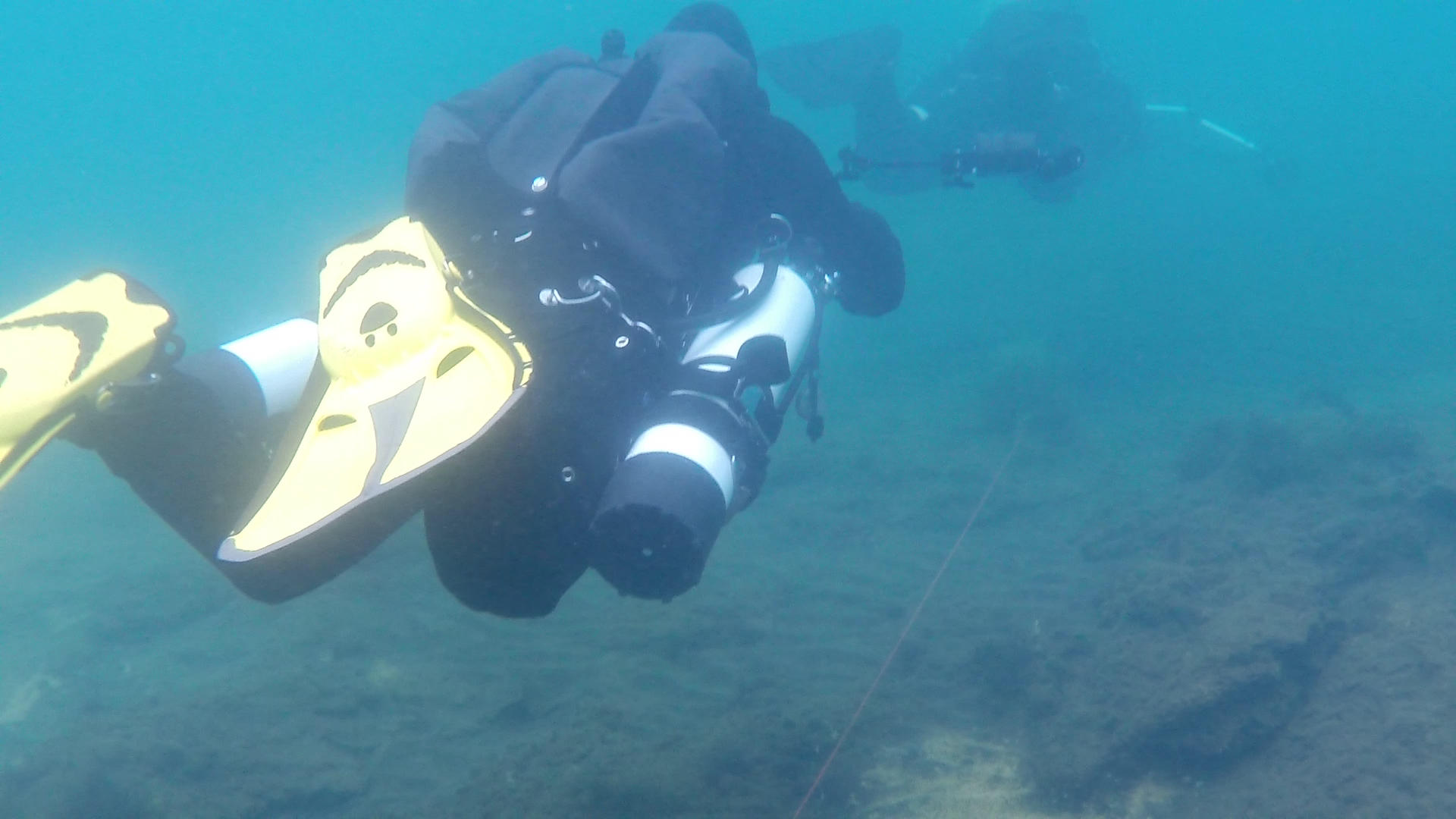
Silence. That’s how every dive begins. It’s not particularly deep, and sometimes you feel the cool air on your back – or at least you think you do. We swim slowly toward the middle of the lake, and just as slowly the bottom drops away beneath us. We’ve found the red line and follow it.
Suddenly the bottom falls away in a steep slope. All at once it’s more than 10m deep and for a moment you can’t make out the bottom anymore. We descend – pressure on the ears, breathe through, deeper. You get the feeling you can smell the sulfur, like outside, where the hot springs release that stench of rotten eggs into the air.
Single bubbles rise from a small opening in the ground. I move slowly toward it, expecting a crab or a fish. But the air comes straight out of a rock. Nothing lives here – here, only the earth breathes.
We descend a little deeper and take a look around. Here and there we find dead fish. Completely intact, not nibbled at, not tangled in trash. Simply lifeless. A few smaller ones swim around us, frantic and not in circles but straight ahead, away.
We reach a small rise. Air hisses into the drysuit and we slowly ascend. Behind the hill the sand is dancing – billions of tiny air bubbles rising from the ground. A jacuzzi the size of a family home, a champagne glass as big as a warehouse. We catch the first bubbles with our thick gloves, collect them in our palms and release them again as big bubbles. Little molehills have formed everywhere, with air bubbles escaping from them. The sand tumbles down a little with every new bubble.
From here on, the dive is one long back-and-forth of looking around. Trying to get your bearings, playing with the bubbles and the camera. There are no more fish here, at least none that swim. No crabs, no plants. There is no life here, but it is alive. The lake breathes here, the earth simmers beneath us.
After a short, thrilling while, the air bubbles slowly fade as we swim on toward the rift fractures. Big holes open up in the ground here, and you could dive along their rock walls down to the deepest parts of the lake. I imagine a hellmouth opening up at the end of these caves, because that must be where the volcanic activity happens that creates the natural spectacle next door.
Eventually we find the red line again, swim slowly along it and at some point climb out of the cold water. Another dive group is already waiting on the shore – it’s a busy day out here. It’s raining pretty hard, so we change quickly under the tailgate of the van.
After the dive in the volcanic lake, we visit one of Iceland’s best-known high-temperature areas at Krýsuvík. On this active volcano you’ll find hot springs, mud pots and fumaroles. Everything here simmers, steams and bubbles.
From here, Reynar from the Icelandic dive school drives us straight to the Blue Lagoon, where we spend the rest of the day in the water as well. Just without the dive gear.
In cooperation with Dive.IS.
[…] Diving in a geothermal lake – Kleifarvatn in Iceland […]