
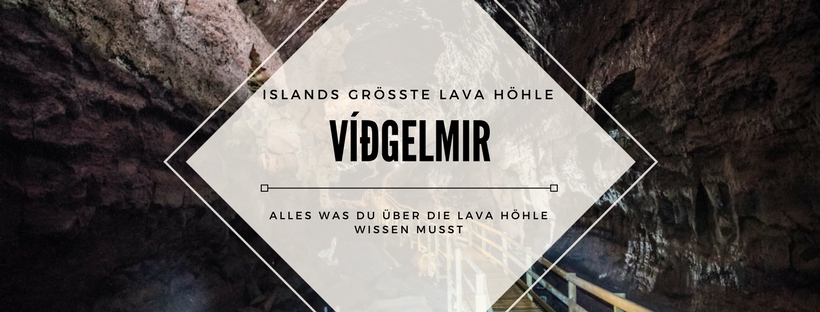
Víðgelmir is Iceland’s largest lava cave, stretching more than 1,500m beneath a lava field near Reykholt, just under 2 hours by car from Reykjavík. This cave is a must-see when you’re travelling on the western side of Iceland — not just because of its sheer size, but also because of its fascinating history. It makes a particularly good side trip before or after a journey to the Snæfellsnes peninsula, as it’s only a small detour from there.
Curtain up for Víðgelmir…
The history of the Víðgelmir cave
The story of Víðgelmir begins around the year 900, at the time of Iceland’s settlement. This is when the Hallmundarhraun lava field was formed, which today is over 50km long and a good 7km wide. The craters the lava flowed from back then lie beneath the Langjökull glacier, Iceland’s second-largest glacier, which is also the water source for the Silfra fissure.
When picturing a volcanic eruption, most people probably imagine a mountain spewing hot lava — not so with the formation of Hallmundarhraun. This was a fissure eruption that presumably went on for several years. In this type of eruption, a crack tears open in the ground, often at the edge of a volcano, and liquid lava emerges to the surface.
For a long time the cave was forgotten, because the icy temperatures had formed a natural seal at the entrance: a huge ice plug blocked the large entrance area for decades. One day, however, it was decided to reopen the cave, and a tunnel was drilled through the ice. In the years that followed, the cave was explored step by step, and it was discovered not only how big it is but also that people actually lived here. Only about 100 years after its formation, the cave seems to have been home to an Icelander, as bones, tools and a leather pouch from that era were found on a rock ledge. The cave was presumably relatively warm back then, even in winter, because the rock cools down very slowly over decades. An effect you can still feel today on the Eldfell volcano on the Vestmannaeyjar: if you dig your hand a little into the ground at the crater rim, you can clearly feel the warmth of the soil.
After the cave was reopened, it turned out that on some days cave enthusiasts and researchers from all over the world were “exporting” rock samples and the like out of the cave by the backpack-load, which is why it was decided to only allow access under supervision. Today the owner of the land, Hörður Ólafsson, offers tours into the cave. A 2-hour tour takes you about 600m deep into the cave and gives you a very good overview of the insides of a lava tunnel, its rocks and its peculiarities. If your spirit of discovery wants more, you can book an individual tour that takes you deep into the cave in just under 4 hours, all the way to the end of the tunnel, which is over 1.5km long.
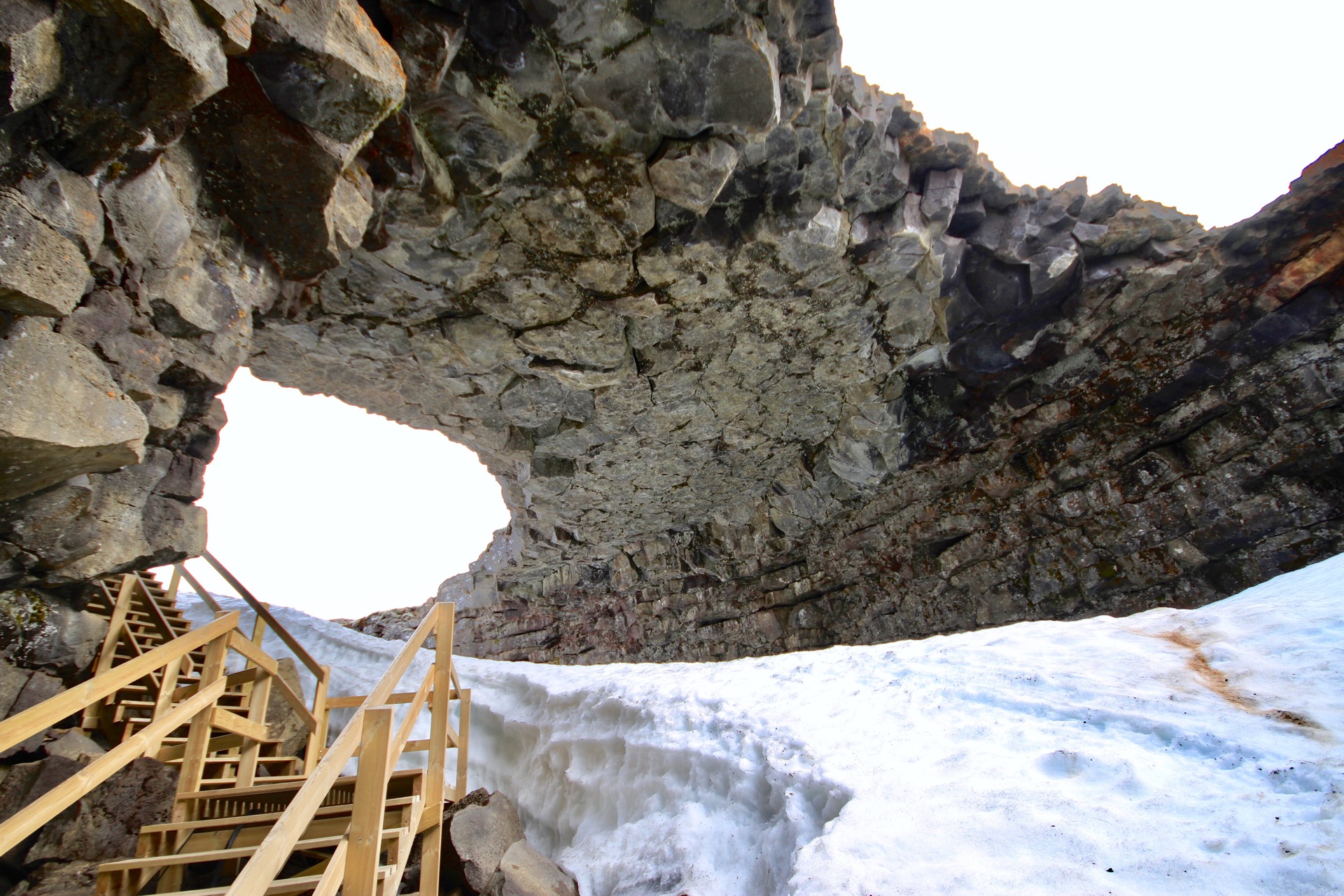
Inside the cave it’s usually around 0°C, but since there’s no wind it doesn’t feel that cold at all. Gloves and a hat are still a good idea. The operators provide helmets and lamps. If you want to take photos, you’ll need to bring a tripod and some time: only long exposures make sense here, and accordingly you’ll also need the consideration of the other group members.
The geology of the Víðgelmir lava cave
On the tour you get an overview of the different types of lava, their manifestations inside the cave, and the peculiarities of the geology at this place in general.
Fundamentally, lava caves like this one form because the flow of lava eventually comes to a halt. Under certain circumstances, a tunnel like this then forms, and at some point the lava drains away at its end.
There are three main types of lava: Pahoehoe, ʻAʻā and pillow lava. These terms come from Hawaiian. Pahoehoe is slow-flowing lava, and you can later recognise it by the wave-like patterns in the rock. ʻAʻā lava flows very fast and cools down just as quickly. Small chunks are then often dragged along over long distances, forming the jagged little stones you often see.
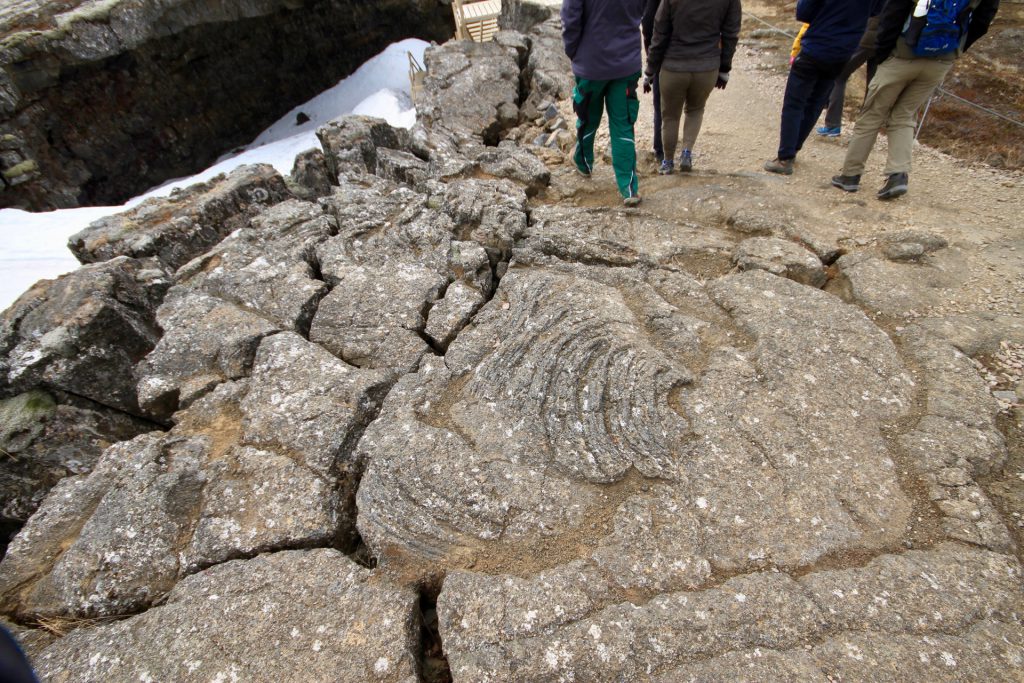
Lava caves form mainly in areas of Pahoehoe, so it can be assumed that more caves lie hidden beneath the lava fields around Hallmundarhraun. Evidence of further large chambers has already been found, but these will not be opened. Here they put their trust entirely in Mother Nature and keep their fingers crossed with every earthquake in the region that an entrance will open up.
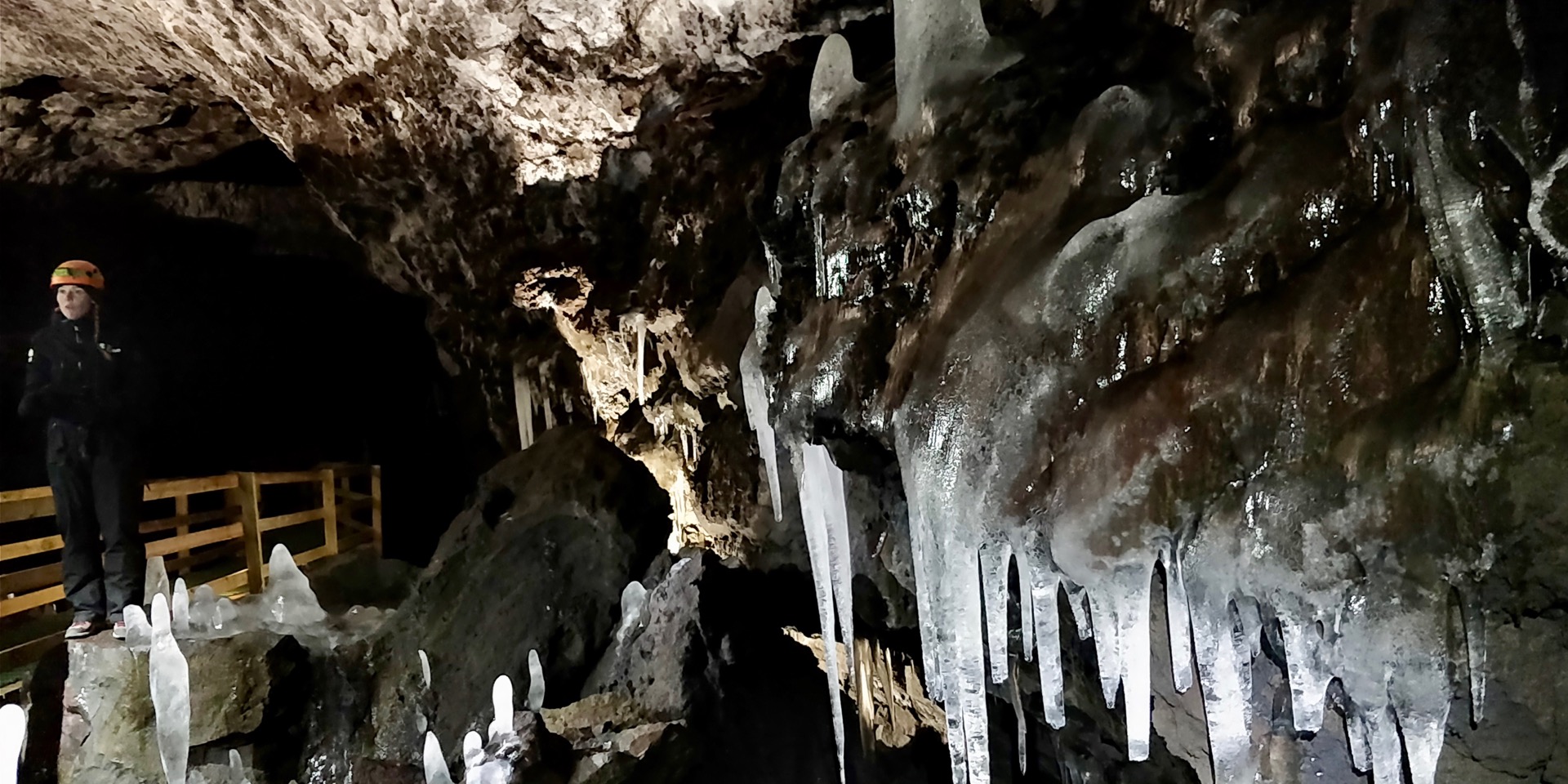
In lava caves like Víðgelmir you can then discover various fascinating rock formations and geological peculiarities. Lava needles, for example, form from dripping lava and are, astonishingly, often hollow. Like stalactites, which grow downwards from the ceiling in sandstone caves, the lava needles hang from the ceilings of this cave. They no longer grow and are preserved in exactly the length and shape in which they cooled a few days after the lava flow in the cave ended. Over 1,000 years ago, in this case.
On the ground you’ll often find the counterpart with the fitting name lava poo. This is the lava that dripped down from the ceiling and cooled on the floor. Small piles often form in the process, looking like a candle that has been melted down over a longer period of time.
More information is available on the tour to the Víðgelmir lava cave.
(Book the tour)
The tours to and inside Víðgelmir
Víðgelmir lies just under 2 hours by car north of Reykjavík and is therefore perfectly suited as a day trip. Especially because there are a few other sights along the way that you can visit before or after the tour through the cave.
The tour itself takes just under 2 hours and is easily manageable for everyone — children can take part in the tour as well. For wheelchair users this tour is also doable. To protect the rock and the paths, a wooden walkway has been built inside the cave, on which you can descend about 500m into the depths of the tube. After a short, somewhat narrower passage, the rest of the cave is enormous, so claustrophobia shouldn’t be an issue.
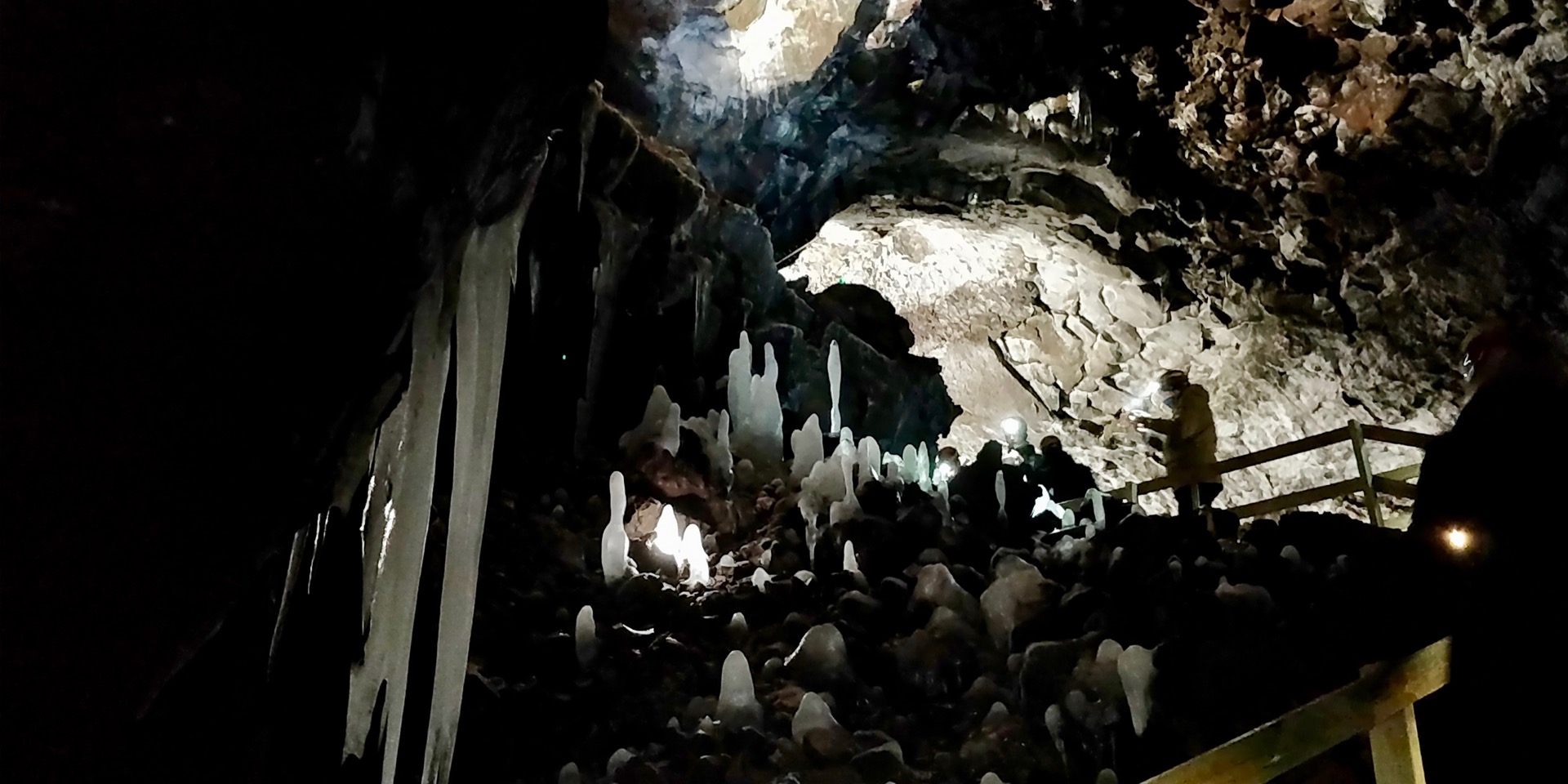
If that’s not enough for you, you can book an individual tour into the cave: this one doesn’t end at the wooden walkway — that’s where it really begins. The path then leads almost another 1,000m over rocks and rubble into the depths of the Icelandic underworld. Down here there’s only your headlamp — no further lighting or any other structures. I find this tour absolutely recommendable, especially for small groups.
More information is available on the tour into Iceland’s largest lava cave Víðgelmir.
(Book the tour here)
Verdict on the Víðgelmir lava cave
Having already seen two other lava caves in Iceland, Víðgelmir was another big highlight for me. As the largest of its kind, Víðgelmir is truly very impressive and can’t really be compared with most others in Iceland. The sheer size, the well-organised tour and the far-reaching history make Víðgelmir something special, and I can really highly recommend the tour.
I did it myself as part of my West Iceland trip — in my case on the way back from Snæfellsnes via Reykholt to Reykjavík. I stayed one night at the Fosshotel Reykholt, visited the Deildartunguhver geothermal area and also had a look at the new Krauma spa. I haven’t been inside myself, but it’s firmly on my to-do list for my next visit to the region.
Have fun in Iceland!
No Comments Yet